
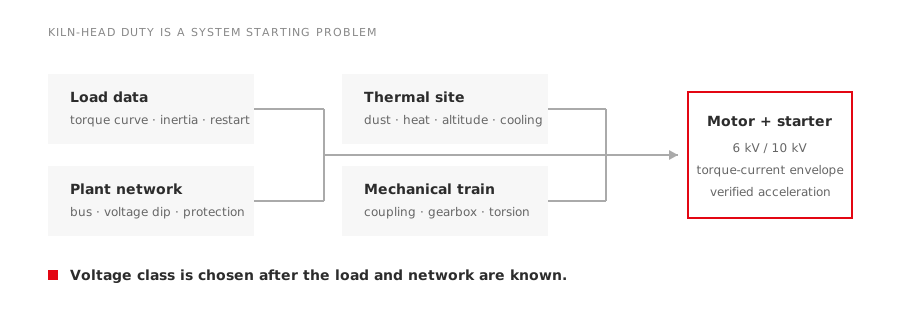
Kiln-head duty combines a large mechanical train, difficult starting conditions and a hot, dusty site. Selecting the motor from a power value and voltage class leaves the most important risks unanswered.
Direct answer
Build the specification in this order:
- driven-equipment torque-speed curve;
- reflected inertia and required acceleration time;
- starting and control method;
- plant supply and permissible voltage dip;
- continuous and cyclic thermal duty;
- cooling, enclosure and site conditions;
- mechanical interface and torsional review.
Only then choose the motor construction and rating.
Get the load data from the equipment supplier
The motor vendor needs more than steady running power. Request breakaway torque, load torque across speed, maximum operating torque, inertia referred to the motor shaft and any process condition that changes the start.
| Input | Why it matters |
|---|---|
| Breakaway torque | Determines whether acceleration begins |
| Torque-speed curve | Shows margin throughout acceleration |
| Reflected inertia | Drives acceleration time and rotor heating |
| Starts from cold/hot | Sets thermal accumulation |
| Process material condition | May change resisting torque |
| Coupling and gearbox data | Affects torsional and mechanical checks |
An unloaded commissioning start may not represent a restart after a process interruption. Define the credible worst starting condition with the kiln or equipment engineer.
Starting is a system study
Across-the-line starting, reactor or autotransformer starting, liquid-resistance arrangements, soft starters and VFDs create different torque, current and thermal conditions. The correct choice depends on the motor and the network.
For every proposed method, confirm:
- motor starting-current and starting-torque curves;
- minimum terminal voltage during acceleration;
- load torque and acceleration time;
- permissible starts from cold and hot;
- switchgear and protection capability;
- effect on other plant loads;
- bypass, harmonic and cooling requirements where relevant.
A current-limiting method can also reduce motor torque. The study must show that the remaining accelerating torque stays positive across the full speed range.
Choose voltage from the plant architecture
A separate guide covers when 6 kV or 10 kV motors make sense. For a kiln-head project, compare the existing bus, switchgear, protection relays, cables, transformer capacity, spares and maintenance competence.
Standardising on the plant’s established voltage can be worth more than a small difference in motor price. A non-standard island creates additional switchgear, training and spare-parts obligations.
Squirrel-cage or wound-rotor
Squirrel-cage designs offer a comparatively simple rotor and low routine maintenance. Their starting performance must still match the network and load.
Wound-rotor motors allow external rotor-circuit control and can be considered where high starting torque with controlled current is central to the design. The trade-off is additional equipment and maintenance: slip rings, brushes, resistor or control gear and their inspection environment.
Do not choose between the two from a generic statement that one “starts better.” Compare the guaranteed torque-current envelope, acceleration calculation, service tasks and installed support.
Dust and radiant heat affect cooling
Cement dust can block external cooling surfaces and contaminate ventilation paths. Radiant heat near process equipment raises the real ambient seen by the motor. High altitude reduces air density and cooling performance.
Provide:
- maximum site ambient and nearby radiant-heat sources;
- altitude;
- dust type and expected accumulation;
- indoor/outdoor location and shelter;
- cooling-water or clean-air availability where applicable;
- cleaning method and interval;
- enclosure and corrosion requirements.
If the area may contain an explosive dust atmosphere, the site’s hazardous-area classification must be completed separately. A cement application does not automatically mean ordinary dust service or explosive-dust service.
Mechanical fit is more than shaft diameter
Confirm shaft dimensions, coupling type, allowable loads, bearing arrangement, frame stiffness, foundation, alignment tolerances and permissible vibration. For a replacement, record soleplate and hold-down geometry rather than relying on frame designation alone.
Large drive trains also need torsional review. Motor electromagnetic torque, coupling stiffness, gearbox data and load inertia interact during starting and disturbances. Responsibility for the torsional calculation should be assigned in the project documents.
Protection and condition monitoring
Typical project discussions include winding and bearing temperature, vibration, differential and earth-fault protection, current unbalance, locked-rotor or stall protection, space heaters and cooling-system alarms. The exact package depends on rating and plant philosophy.
Define sensor types, locations, alarm/trip ownership and signal interfaces before the order. A long list of sensors has little value if the DCS scaling, trip logic and commissioning tests are missing.
Enquiry checklist
- Single-line diagram and bus data.
- Driven-load torque-speed curve and inertia.
- Starting method and voltage-dip limit.
- Normal and emergency duty sequence.
- Ambient, altitude, dust and cooling conditions.
- Mechanical drawings and torsional responsibility.
- Protection, sensors and communication requirements.
- Test, documentation and witness requirements.