
“Is this motor IE3?” is a reasonable question about a 90 kW machine. Asked about a 6 kV machine it becomes a question about scope first, because the answer may be that no class exists — and that would not be a criticism of the motor.
Direct answer
High-voltage cage induction motors do have efficiency classes, assigned by a dedicated part of the IEC 60034 series. But the classification applies inside a window, and the window is specific.
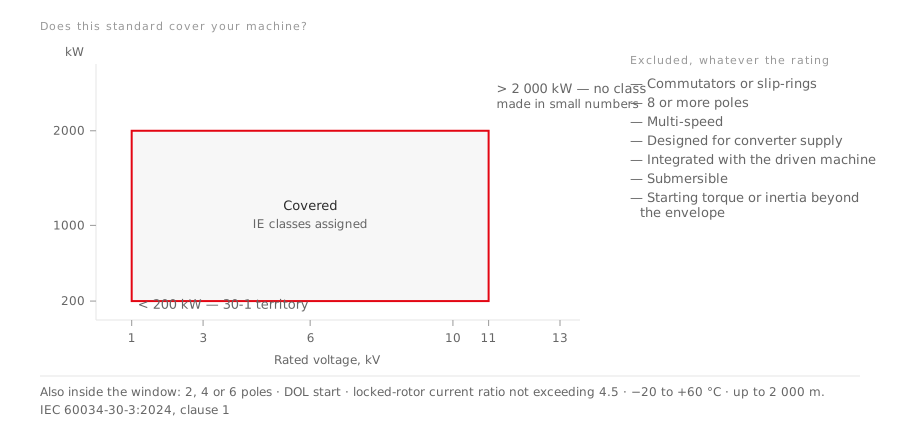
A machine is inside the window if it:
| Condition | |
|---|---|
| Voltage | Above 1 000 V, not exceeding 11 kV |
| Power | 200 kW to 2 000 kW |
| Poles | Two, four or six |
| Operation | Single-speed, line-operated, intended for direct-on-line starting at rated or reduced voltage and rated frequency |
| Cooling | One of the listed methods — IC411, IC511, IC611, IC01 or IC81W |
| Duty | Capable of continuous operation at its rated point within its insulation temperature class |
| Ambient | Rated for −20 °C to +60 °C |
| Altitude | Rated for operation up to 2 000 m |
| Starting current | Locked-rotor to rated current ratio not exceeding 4.5, before any tolerance |
Degree of protection is deliberately not a condition — any enclosure is covered.
What is excluded, whatever the rating
These fall outside the classification entirely:
- Machines with mechanical commutators or slip-rings
- Machines with eight or more poles
- Multi-speed machines
- Machines whose starting torque or external inertia exceeds the envelope the standard defines
- Machines designed specifically for converter supply
- Machines completely integrated with the driven machine — where the motor cannot be separated and run on its own
- Submersible machines designed to operate wholly immersed
Read that list once more with a procurement eye. Several of the most common heavy-industry machines sit on it: slow-speed mill and fan drives on eight or more poles, converter-fed machines, and close-coupled pump units that cannot be separated from what they drive.
“No IE class” and “inefficient” are different statements. The first is about which standard applies. Treating the absence of a class as a mark against a machine is the most common misreading of this subject.
Three details inside the scope worth knowing
Starting current is a scope condition, not a performance note. The ratio of locked-rotor to rated current has to be no more than 4.5 before any tolerance is applied. A machine designed for a harder start — higher starting torque, higher inrush — can fall outside the classification for that reason alone.
Altitude carries two different numbers. The machine may be rated for operation up to 2 000 m, but the rated efficiency and the efficiency class are based on a rating for altitudes up to 1 000 m. Those are not the same figure, and quoting the first where the second is meant overstates what the class covers.
Duty type is broader than S1. Most machines in scope are rated for continuous duty, but the standard is explicit that machines rated for other duty cycles are also covered if they are capable of continuous operation at their rated power. So a non-S1 nameplate does not by itself put a machine outside.
Why the standard stops at 2 000 kW, in its own words
This is unusually candid for a standards document, and it is worth quoting because it pre-empts the obvious question:
The note attached to the scope gives the reasoning: machines of that size are built in very small numbers, each already designed around optimum efficiency while meeting increasingly specialised requirements, so a class label would be extra effort producing no energy saving anyone could count.
At that size, in other words, every machine is already a bespoke efficiency exercise, and the label would add paperwork rather than savings. That reasoning is also a useful thing to be able to repeat when a specification asks for an IE class on a 3 000 kW machine.
What this means when the machine is outside the window
You have not lost the ability to compare machines — you have lost the shorthand. What replaces it:
- The declared efficiency value at the rated point, with the test method standard it was determined by. A number without its method is not comparable with anyone else’s.
- The tolerance that applies to that declared value.
- The operating point you actually run at, since efficiency at rated load is not efficiency at 60 % load.
- For converter-fed machines, efficiency determined on a converter supply rather than a sinusoidal one — a separate measurement with its own standard.
That is more work than reading a class off a nameplate, which is exactly why the classes exist where they do.
What to ask for
- Is the machine inside the scope — voltage, power, poles, starting arrangement.
- If it is, the class and the test method standard behind it.
- If it is not, which exclusion applies — that tells you whether it is a pole count, a converter design or an integration question.
- The declared efficiency and its tolerance, in both cases.
- The altitude basis of the declared figure, not just the altitude the machine is rated for.
LEADGO’s high-voltage range spans ratings on both sides of this window — some machines sit inside it and carry a class, and others fall outside it on power or pole count. Asking which of the two applies to a specific rating is a better first question than asking for a class, because on part of the range the honest answer is that no class is defined.
Going deeper
- GB 18613 and IE efficiency classes — the low-voltage side, and how the Chinese grades map onto IE
- Drive system efficiency, IE and IES — what happens to efficiency classification once a converter is in the picture
- Type test versus routine test — where a declared efficiency value comes from, and what a report proves
- NEMA MG 1 explained — the North American system, which classifies efficiency on different boundaries again