
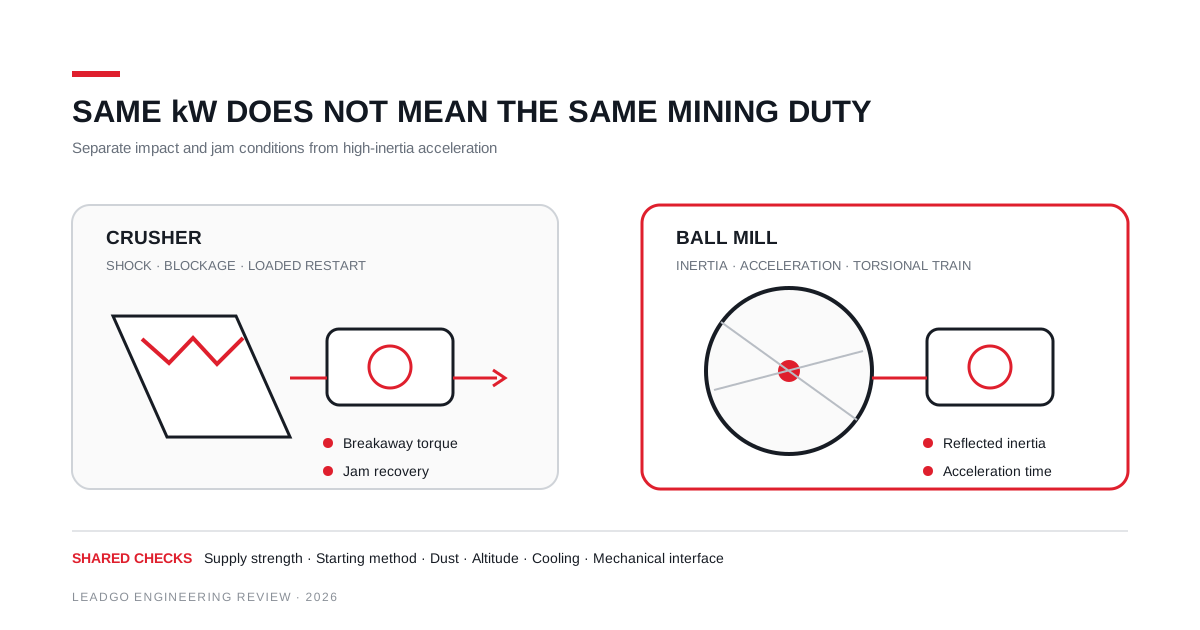
Crusher and ball-mill enquiries often arrive with the same three fields: voltage, power and speed. Those fields identify a rough motor size. They do not prove that the drive will start, survive a jam or accelerate the mill without overheating the motor or collapsing the bus voltage.
The two machines need different questions.
Crusher duty: shock, blockage and restart
A crusher can see changing feed, impact loading and a sudden stall. The motor must have enough accelerating torque for the real starting condition and enough thermal capacity for the permitted restart sequence.
Request these inputs from the crusher supplier:
- breakaway torque, unloaded and with the credible retained load;
- torque-speed curve;
- combined inertia referred to the motor shaft;
- normal load variation and peak torque duration;
- jam-clearing and reverse-jogging procedure, if used;
- starts per hour and hot-restart requirement;
- coupling, pulley or gearbox loads at the motor shaft.
Do not assume that “starts empty” is always true. A process trip can leave material in the chamber. Define whether the operating procedure clears the machine before restart or expects the drive to recover under load.
Ball mill duty: inertia and acceleration
A ball mill is a high-inertia drive. During acceleration, the motor may carry high current for much longer than a simple pump or fan. The calculation needs the total reflected inertia, load torque across speed, desired acceleration time and minimum motor-terminal voltage.
| Engineering input | Crusher | Ball mill |
|---|---|---|
| Dominant transient | Impact, blockage or loaded restart | Long acceleration of a large rotating mass |
| Required load data | Breakaway and peak torque | Torque-speed curve and reflected inertia |
| Key thermal question | Repeated starts and jam events | Rotor and stator heating during acceleration |
| Mechanical review | Shock, belt/coupling and shaft loads | Coupling, gearbox and torsional train |
| Process interlock | Feed and clearing sequence | Lubrication and permissive sequence |
For the mill, define the lubrication permissives, inching or barring arrangement and the state in which a restart is allowed. These operating details change the motor duty more than a generic service factor.
Starting method and mine power system are one study
Across-the-line starting, reactor or autotransformer starting, liquid-resistance arrangements, soft starters and VFDs produce different current and torque. A method that limits current may also reduce available accelerating torque.
The study should plot motor torque and load torque against speed, then calculate acceleration time at the minimum expected terminal voltage. Check the result against motor thermal limits and the number of permitted starts from cold and hot.
At mines with long feeders or a weak bus, cable drop and transformer impedance can be decisive. Provide the single-line diagram, fault level or equivalent source data, cable length, transformer rating and permissible voltage dip. Our motor starting-method comparison outlines the options; large drives still need a project-specific calculation.
Voltage and construction follow the system
High voltage may reduce current for a large drive, but it also brings switchgear, protection, cable termination and maintenance requirements. Select voltage from the site’s distribution architecture and installed standards, not from a universal power threshold.
Motor construction depends on the load, speed-control need and maintenance philosophy. A squirrel-cage induction motor offers a robust, familiar arrangement. Wound-rotor or variable-speed solutions may be considered where starting or process control justifies the added equipment. The proposal must be assessed as a complete drive, not as a motor-only substitution.
The mine environment changes the thermal design
Dust accumulates on cooling surfaces and can enter ventilation paths if the enclosure permits it. Altitude reduces air density. High ambient temperature, solar exposure and restricted equipment rooms further reduce cooling margin.
State the actual maximum ambient, altitude, dust character, water availability, corrosion exposure and cleaning practice. Confirm enclosure and cooling arrangements against those conditions. If explosive gas or dust may be present, hazardous-area classification is a separate site-led requirement.
Maintenance access deserves equal attention. Record lifting limits, route dimensions, bearing-change access, cooler-cleaning space and the site’s ability to align the drive train.
Mechanical and monitoring package
For both machines, specify shaft and coupling details, allowable radial and axial loads, foundation data, alignment tolerances and vibration limits. Ball-mill trains may require a torsional study covering motor, coupling, gearbox and mill inertia.
Monitoring commonly includes winding and bearing temperature, vibration, current unbalance and cooling-system status. Put sensor types, locations, alarm/trip ownership and DCS interfaces in the order. Vibration analysis is most useful when the baseline and measurement points are defined during commissioning.
RFQ checklist
- Driven-equipment torque-speed curve and reflected inertia.
- Empty, normal, blocked and restart conditions.
- Starts per hour, hot starts and acceleration target.
- Single-line diagram, source data and voltage-dip limit.
- Starting or speed-control method.
- Ambient, altitude, dust, cooling and corrosion data.
- Mechanical drawing, coupling and torsional responsibility.
- Protection, monitoring, testing and documentation.
LEADGO’s YKK/YXKK high-voltage motor range can be evaluated for suitable large mining drives. The selected rating and starting method still have to be proven against the crusher or mill calculation.