
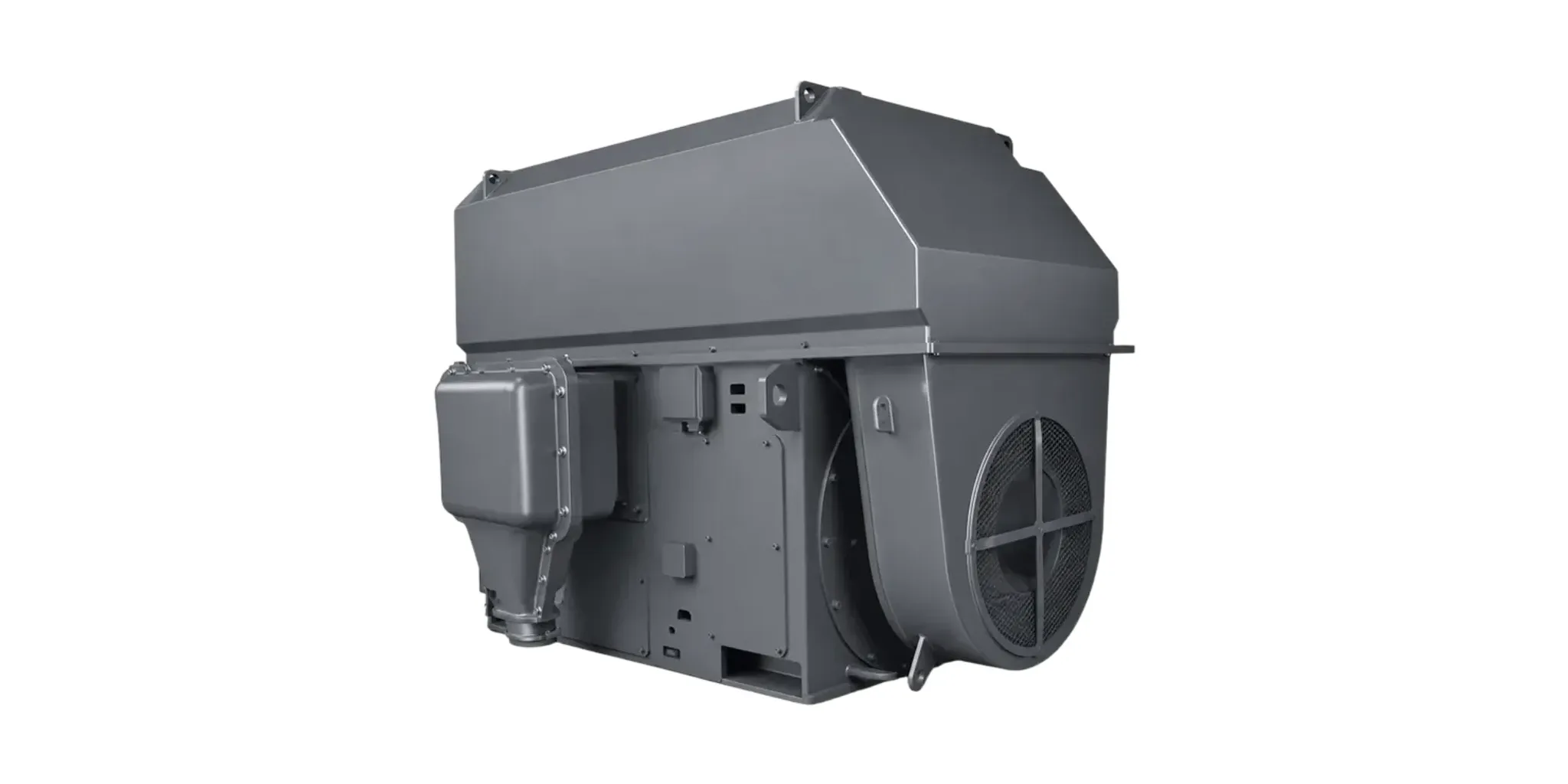
A gas compressor package arrives with a motor specification that is usually right on power and often wrong on everything that decides whether the machine survives its first year. The two compressor families ask for different things, and the differences are not a matter of degree.
Direct answer
| Reciprocating | Centrifugal (high speed) | |
|---|---|---|
| Usual electric drive | Slow-speed synchronous motor | Four- or six-pole induction motor with a gear increaser |
| Coupling | Direct at compressor speed | Through a speed increaser |
| Torque character | Pulsating, at piston frequency | Smooth, roughly squared with speed |
| What decides the motor | Holding speed against pulsation | The start: torque at in-rush voltage, and thermal capacity for 20–30 s |
| Common competitor | Reciprocating gas engine | Gas turbine |
One point of context before the detail: on natural gas pipelines, compressor drivers are usually reciprocating gas engines or gas turbines, precisely so the installation can use the energy already available in the pipeline. An electric drive is a deliberate choice against that default, and it is chosen for reasons — emissions, maintenance, remote control, grid availability — that sit outside this article.
Reciprocating: slow speed, synchronous, directly coupled
A reciprocating compressor is a positive-displacement machine, and its torque pulses at piston frequency in the same way a mud pump’s does. Two consequences follow, and they point at the same machine:
Speed. A reciprocating compressor runs slowly. A slow-speed synchronous motor can be coupled to it directly — no gear increaser, no gearbox to maintain, no extra torsional element in the train.
Stiffness. A synchronous machine runs at synchronous speed and holds there. Against a pulsating load torque it resists being pulled around, where an induction machine would be riding its slip curve back and forth with every stroke.
The design work that this pushes onto the project is torsional analysis of the complete train — motor, coupling, flywheel and compressor together. That is a system-integration scope, not a motor datasheet item, and it belongs in the package engineering rather than in the motor enquiry. What the motor enquiry needs to carry is the load’s torque-versus-angle character, so the machine can be built for it.
Centrifugal: the start is the specification
This is where motors get lost. The petroleum engineering literature puts two requirements on a motor driving a centrifugal compressor, and it is worth separating them because they fail separately:
- It must produce enough torque at whatever voltage is actually available during in-rush to accelerate a high-inertia load.
- It must have the thermal capacity to survive the acceleration, which may run 20 or 30 seconds.
Torque at the available voltage. In-rush pulls the terminal voltage down, and motor torque falls roughly with the square of voltage. A machine that develops ample torque on the nameplate may not develop it on a weak feeder at the moment it matters — and a centrifugal compressor is a high-inertia load that will not tolerate a lazy acceleration.
Thermal capacity for the duration. A 20-to-30-second acceleration is a long time to sit at several times full-load current. The heat goes into the rotor bars and the winding faster than it can leave. This is the failure that looks like success: the machine starts, the operator sees it run up, and the damage is cumulative and invisible.
Which is why a compressor enquiry should state the starting duty — how many starts per hour, hot and cold — as explicitly as it states the power. Two starts an hour on a 25-second acceleration is a fundamentally different machine from one start a day.
What the drive has to do, if there is one
Where the machine is inverter-fed, the converter carries requirements of its own:
- Supply a low-harmonic voltage waveform while allowing the amplitude to be adjusted, so the motor does not magnetically saturate as the frequency changes.
- Below base speed, voltage is adjusted proportional to frequency — the constant-torque region. Above base speed the voltage is held constant, flux density declines, and the machine runs at roughly constant horsepower.
- Limit the starting current.
- Ensure operation at favourable slip.
- Provide a path for reverse power flow during motor slowdown.
That last item is easy to skip past on a compressor and expensive to skip past in practice: a high-inertia load decelerating drives the machine, and the energy has to go somewhere.
Classification: the same package, two different answers
The literature makes a distinction worth carrying into every compressor enquiry:
Outdoors, installations of this kind commonly fall under Class I, Group D, Division 2. Weather-protected Type II, totally enclosed fan-cooled, and drip-proof-with-weather-protection enclosures are all suitable there. The drip-proof type is widely used — it is less expensive than the alternatives and carries a service factor of 1.15.
Indoors, a Division 1 classification is likely to apply to the same equipment. The motor must then be Class I, Group D explosion-proof, or separately ventilated with clean outside air brought to it by fans.
So “put the compressor in a building” is not a neutral decision about weather. It can change the motor from a general-purpose machine into a certified one.
And the item that gets missed most often: auxiliary devices such as alarm contacts on the motor must themselves be suitable for the area classification. Winding temperature detectors, vibration switches, space heater circuits — all of it lives in the same atmosphere as the machine.
A related note from the same source, which explains a pattern visible across oilfield equipment: DC commutator motors are not acceptable in certain applications, and the examples given are hazardous atmospheres and high motor velocities. We saw the same argument retire DC from top drives on drilling rigs.
What to settle before asking for a quotation
- Compressor type — reciprocating or centrifugal. This selects the machine family before anything else.
- The starting duty — starts per hour, hot and cold, and the expected acceleration time.
- The supply — voltage at the terminals under in-rush, not open-circuit.
- Indoors or outdoors, and the classification drawing that follows from it.
- The auxiliaries — which contacts and detectors are required, and that they suit the classification too.
LEADGO’s high-voltage range covers the ratings compressor duty usually lands in, and YVP is the inverter-duty machine where cooling has to hold up across a speed range. Send the starting duty with the enquiry — it is the number that changes the answer.
Going deeper
- Drilling rig motors: drawworks, mud pump and top drive — the other reciprocating load on an oilfield site, and the same DC-versus-AC argument
- Motor duty types S1 to S10 — where repeated long starts stop being S1 and become S4
- Hazardous area classification: who does it and who carries the risk — the drawing that settles the indoor/outdoor question above