
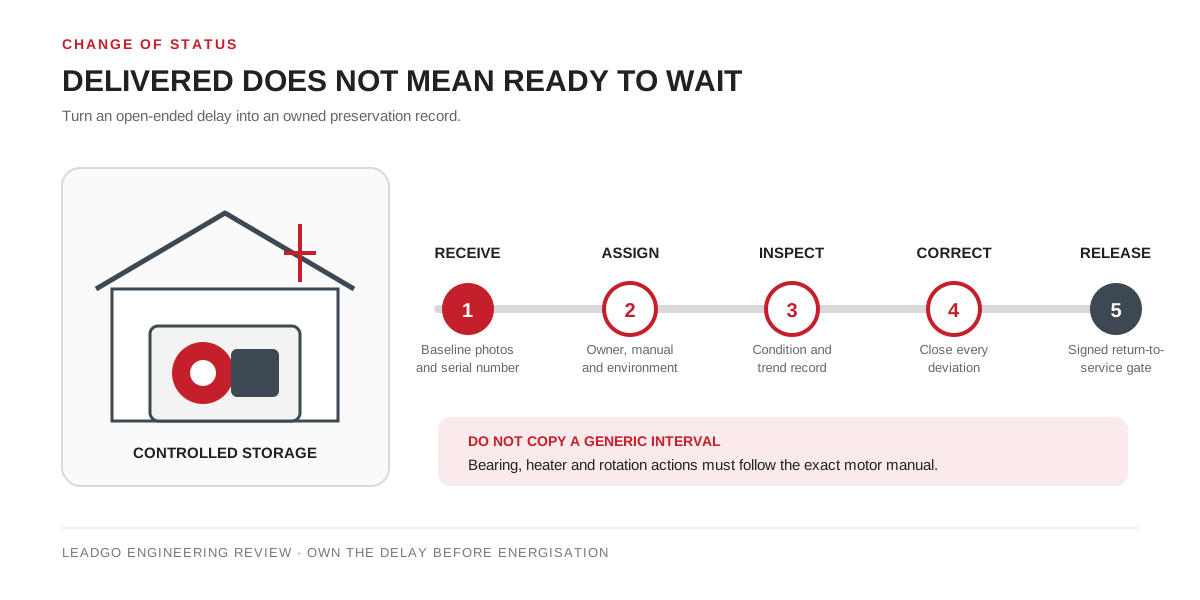
A motor delivered on time can still arrive too early for the project. When civil work, cabling or driven equipment slips by months, the motor changes status: it is no longer merely “awaiting installation.” It is an asset under preservation.
That change deserves a controlled decision. Shipping protection was designed around a transport route and an expected delivery sequence; it is not proof that moisture, vibration, corrosion and bearing condition will remain controlled through an open-ended delay.
Open a preservation record when the schedule changes
The project should issue a storage-change notice with the motor serial number, location, arrival condition, revised commissioning window and responsible person. Attach the manufacturer manual for the exact design, because bearing type, enclosure, heater arrangement and transport restraints change the required actions.
Record the first inspection before rearranging the package. Photographs should show crate condition, shock or tilt indicators if supplied, exposed machined surfaces, terminal boxes and any sign of water entry. Later photographs are useful only when they can be compared with this baseline.
Convert risks into owned controls
| Observed condition or change | Control owner | Evidence to retain | Return-to-service consequence |
|---|---|---|---|
| Package damaged or wet | Site logistics and quality | Receiving report, photographs and supplier disposition | Inspect affected surfaces and internal condition before acceptance |
| Storage location changed | Project preservation lead | New environment record and approved relocation method | Reassess moisture, vibration, support and access controls |
| Space heater required by the motor manual | Electrical/site team | Supply check and periodic operating record | Prove heater circuit and inspect for condensation before energisation |
| Shaft or bearing action becomes due | Mechanical maintenance | Signed action log using the exact manufacturer instruction | Complete overdue action and assess bearing condition |
| Insulation trend changes | Commissioning electrical lead | Raw readings, temperature and test method | Investigate moisture or contamination before applying power |
| Commissioning date is released | Commissioning manager | Approved de-preservation checklist | Remove restraints and temporary protection; close every deviation |
This matrix avoids two weak arrangements: “the warehouse will look after it” and “the commissioning team will check it later.” Each risk has an owner while the motor is still in storage.
Do not universalise bearing instructions
ABB’s long-term machine guidance includes recorded storage conditions and specific actions for anti-friction and sleeve-bearing machines. Its low-voltage manual library also separates general motors from special designs. That is a useful reminder that one copied rotation or lubrication interval is not a company-wide rule.
Before anyone turns the shaft, identify transport locks, bearing type and coupling condition. Before adding grease, confirm lubricant compatibility, quantity and the manufacturer’s storage instruction. An action intended to preserve one design can harm another if its bearing arrangement is different.
Trend electrical condition with the same method
Insulation readings become more valuable when test voltage, winding temperature, humidity context and connection method are recorded consistently. A single number without the measurement conditions cannot show whether a later change comes from the motor or the test.
Keep heaters, desiccants and covers within the approved storage configuration. Energising a heater inside inappropriate sealed packaging can create a different risk, so the motor manual and package design must be reviewed together.
Build the de-preservation gate before the rush
The day commissioning restarts is the worst time to invent the checklist. Prepare it while the motor enters storage. At minimum, the gate should cover:
- incoming and final visual condition;
- removal or reinstatement of every transport restraint as required;
- bearings, lubrication and free rotation under the approved procedure;
- insulation, terminals, grounding, sensors and space heaters;
- drains, breathers, corrosion protection and internal cleanliness;
- alignment and driven-equipment interfaces after installation;
- supplier disposition for every preservation deviation.
Release the motor only when the signed preservation log matches the serial number and the return-to-service actions from the applicable manual are complete. A clean exterior is not evidence that the internal condition is ready for energisation.