
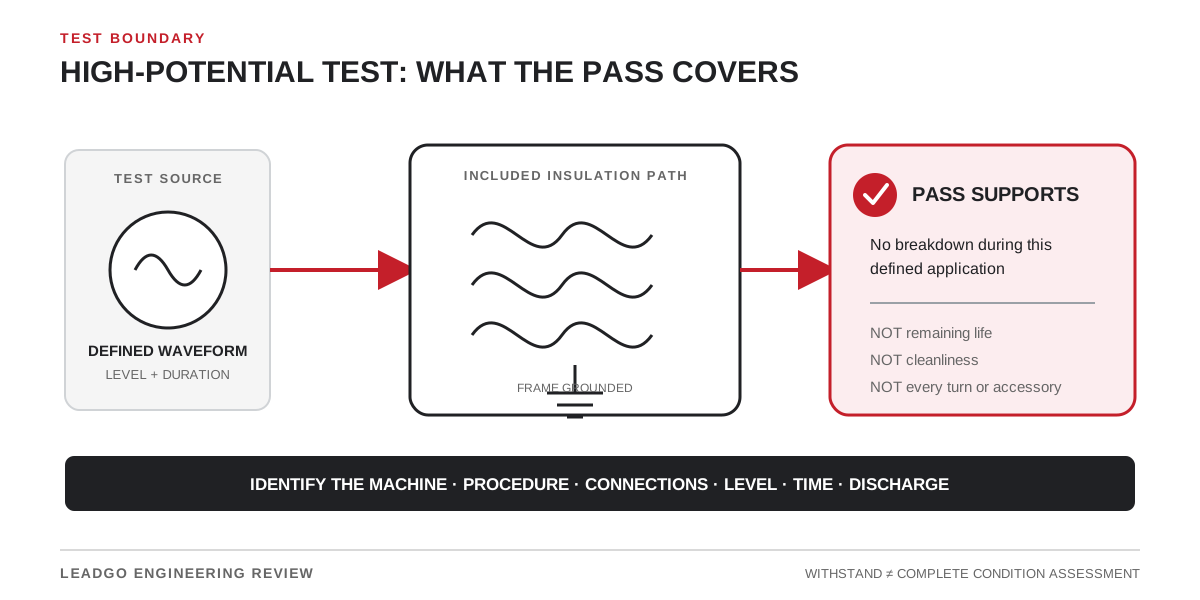
A high-potential test has a narrow job: it challenges insulation between the energised winding and grounded parts under a stated procedure. If no breakdown occurs, the winding has passed that particular withstand test. The result does not reveal remaining life, locate contamination, assess every turn-to-turn weakness or confirm that disconnected accessories are healthy.
Name the test before selecting the voltage
The phrase “hipot test” is not enough for a purchase order or service report. The applicable requirement changes with the condition of the machine and the purpose of the work.
| Test identity | Question that must be answered first | Governing evidence |
|---|---|---|
| New machine at the factory | Which routine or acceptance requirement applies to this design and contract? | Motor data sheet, approved test plan and applicable machine standard |
| Newly rewound winding | What test is permitted after the repair sequence, and what prior exposure has the winding received? | Repair specification, winding record and ANSI/EASA AR100 or another named repair standard |
| Installed machine after site work | Which cables, surge devices, sensors and auxiliaries remain connected? | Site test procedure, connection diagram and equipment instructions |
| In-service condition investigation | Is a withstand test justified, or would a lower-stress diagnostic answer the maintenance question? | Asset history, risk review and responsible engineer’s test instruction |
IEC 60034-1:2026 is the current IEC general standard for rotating machines. The 2026 revision specifically notes clarification of test voltage for old machines after rewinding. ANSI/EASA AR100-2020 covers repair practice and expressly says that it does not replace customer, manufacturer or other applicable requirements. Those scopes are why a voltage copied from an unrelated report is not an acceptable test basis.
What the result covers—and what it leaves open
The evidence boundary is easiest to see in two columns.
| Supported by a documented pass | Not established by the pass alone |
|---|---|
| No breakdown occurred in the included insulation path during the stated application | Expected remaining service life |
| The test circuit reached the recorded level for the recorded duration | Freedom from conductive dust, oil or moisture |
| The connected winding-to-ground insulation tolerated that stress | Condition of equipment that was isolated from the circuit |
| The instrument and operator observed the recorded leakage behaviour | Turn-to-turn integrity throughout the winding |
| The machine can be compared with the acceptance rule named on the report | Suitability for a different voltage, waveform or repetition of the test |
This distinction matters during procurement. “Hipot passed” is not a substitute for a signed report that identifies the machine, procedure and complete test boundary.
Build a controlled test record
Before energising the test set, isolate the motor, prove the work area safe and follow the motor and instrument manufacturers’ discharge instructions. The approved procedure should identify:
- the motor serial number and the winding section under test;
- whether the machine is new, rewound, repaired, installed or in service;
- all cables, RTDs, space heaters, surge components and electronic devices included or disconnected;
- the waveform, target level, application time and ramp method required by the governing document;
- instrument identity, calibration status, connections and grounded parts;
- leakage-current behaviour, interruptions and the final result;
- completion of discharge and restoration of isolated circuits.
If any field is missing, the reviewer cannot tell whether the result belongs to the machine configuration being approved.
Use other evidence for other questions
Choose the diagnostic to match the suspected failure mechanism. Insulation resistance and polarization index describe DC leakage and time-dependent current under their own controlled conditions. Surge comparison testing addresses turn-insulation behaviour when the winding construction and comparison method are suitable. Visual inspection may reveal tracking, contamination or movement that a single electrical result cannot explain.
The test plan should therefore state what each test is expected to detect. Stacking tests without a defined question adds electrical stress while producing a report that is difficult to interpret.
Release decision
Accept the high-potential result only when the test identity is correct, the governing procedure is named, the circuit boundary is documented and the recorded result meets that procedure. Treat every broader conclusion—cleanliness, remaining life, turn insulation or service reliability—as a separate engineering judgement supported by separate evidence.
Related reading: