
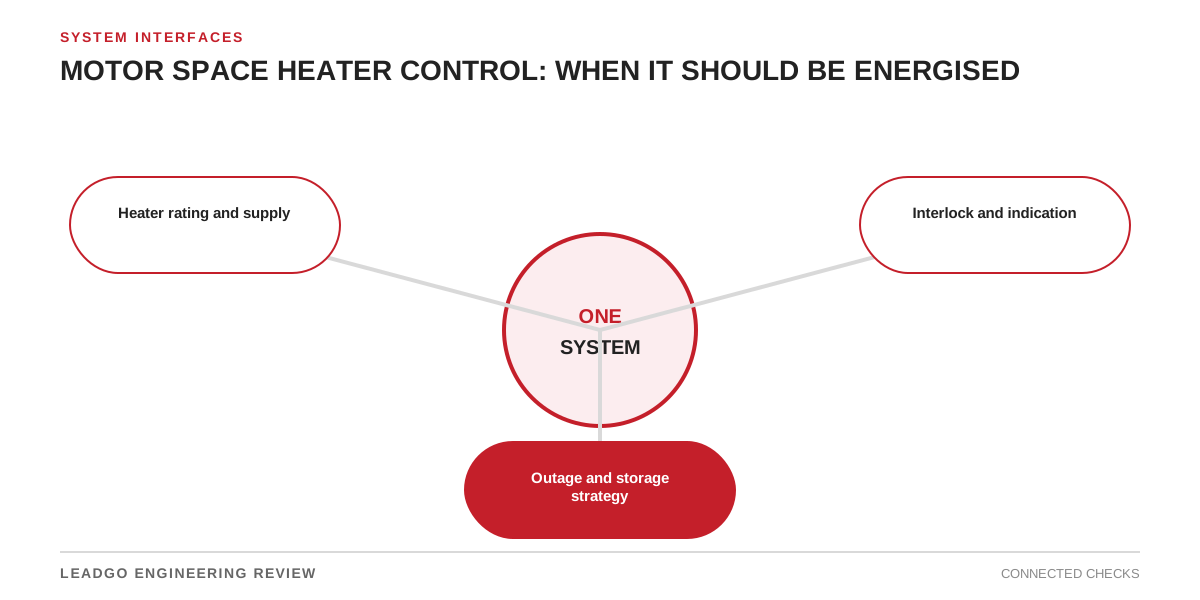
Condensation can form when a stopped motor cools below the surrounding air’s dew point. A space heater reduces that risk, but only if the control scheme matches storage, standby and maintenance conditions.
| Motor state | Heater command | Required safeguard |
|---|---|---|
| Running | Normally off | Electrical interlock |
| Ready but stopped | On when condensation risk exists | Status indication |
| Maintenance | Isolated and proved dead | Lockable isolation/label |
| Long outage | Defined by preservation plan | Periodic inspection |
Record heater voltage, power, phase, terminal numbers and whether its supply is external to the motor starter. A separate auxiliary source must remain visible on schematics and warning labels.
Approval and test points
Decide whether loss of heater supply needs an alarm based on consequence and standby duration. Avoid control logic that cycles excessively or leaves the heater energized during motor operation without manufacturer approval.
Commission with the motor stopped and running: measure supply, prove interlock changeover, test isolation and inspect drains and terminal sealing. For stored motors, combine heater use with insulation-resistance trending and preservation instructions.
Related reading: coastal motor specification and insulation resistance testing.