
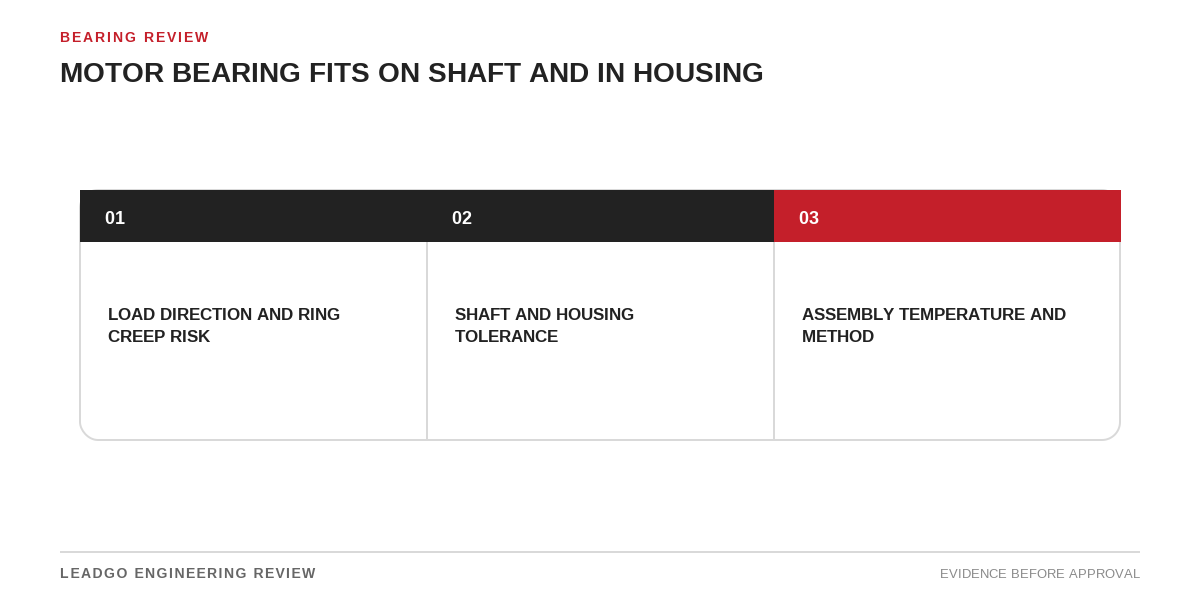
Choose a motor bearing fit from the load and movement expected at each ring, then verify the actual shaft or housing dimensions, bearing clearance and approved assembly method. A fit selected only by bearing bore can be wrong for the load direction or ring that must remain located. Preserve the bearing’s complete designation and the manufacturer’s instructions when requesting a replacement or planning assembly.
For a bearing review, send the motor type and serial identity, bearing designation, shaft or housing measurements, and service observations. Include the direction and nature of the load, operating conditions and whether the motor is new, repaired or being inspected after a failure. This helps distinguish design confirmation from a repair investigation.
Scope and limits
This worksheet helps maintenance and procurement teams gather the evidence needed to review fits on a motor bearing inner or outer ring. It does not prescribe an interference value, tolerance class, heating method or repair procedure. Those depend on bearing type, dimensions, load, speed, material, temperature and manufacturer instructions. A qualified bearing or motor specialist should approve the actual fit and assembly plan.
SKF’s rolling-bearing catalogue explains how bearing designations and fit considerations relate to operating conditions. ABB’s motor manual provides model-specific installation and maintenance instructions. Use each source within its stated scope and prioritize the instructions for the motor and bearing supplied.
This article addresses fit selection and evidence. The bearing internal-clearance guide explains why the bearing’s internal clearance designation is a separate input, while the bearing storage and handling guide covers preservation before assembly. Those controls complement fit review but do not establish a tolerance.
Establish the ring load condition
Identify which ring rotates relative to the load and whether the load direction is fixed, rotating or variable. The inner ring often rotates with the shaft in common motor arrangements, but application details matter. Record the actual arrangement instead of assuming a generic motor case. If the load direction changes during operation, include its credible range and ask the bearing specialist to determine the design case.
Determine which ring must be axially located and whether a locating or non-locating bearing arrangement is used. A fit review should not unintentionally prevent the intended axial movement. Check shoulders, spacers, end covers and retaining components against the assembly drawing. Thermal expansion and bearing internal clearance are related to the complete arrangement, not just the shaft diameter.
Capture the bearing’s full designation, including suffixes. SKF’s designation guide shows that prefixes and suffixes can identify design features beyond the basic size. A shortened number may conceal a variant important to clearance, sealing or internal design. Do not substitute a visually similar bearing without a documented comparison and approval.
Bearing fit decision worksheet
Complete one record for each bearing position. Attach measurement records and identify the instruments and procedure used, rather than transcribing a lone final value.
| Review field | Evidence to capture | Decision question |
|---|---|---|
| Motor identity | Type, serial, frame and build or repair record | Does the evidence belong to this machine? |
| Bearing location | Drive or non-drive end and arrangement role | Which ring carries the locating function? |
| Full bearing designation | Manufacturer, complete code and revision/source | Is the proposed bearing the specified variant? |
| Load direction | Radial, axial, combined and direction changes | What load does each ring experience? |
| Ring movement | Shaft rotation, stationary housing and load relation | Which ring is at risk of creep? |
| Shaft measurement | Method, location, temperature and recorded dimensions | Does the journal match its controlled drawing? |
| Housing measurement | Bore locations, method and measured condition | Is the seat round and within its approved basis? |
| Clearance condition | Bearing initial data and approved post-fit check | Does the fit preserve required internal condition? |
| Assembly method | Manufacturer instruction and tools | Is the procedure suitable for this bearing and motor? |
| Final verification | Runout, seating, axial movement and record references | What proves the assembly matches the released arrangement? |
The table deliberately contains no generic tolerance recommendations. Use the project drawing, bearing supplier guidance and approved repair instructions for actual limits. If measurements disagree, stop the fit decision until datum, instrument, temperature and surface condition are reconciled.
Decision steps before ordering or assembly
- Confirm the motor identity and bearing position from the current drawing or repair record.
- Verify the complete bearing designation and the supplier’s stated applicability.
- Describe the load direction and the movement expected at both rings.
- Obtain shaft and housing measurements using the approved method and identified datums.
- Ask the responsible specialist to select or confirm the fit and any clearance checks.
- Review the assembly method, tools, temperature controls and restoration steps against the manufacturer procedure.
- Record the final measurements and fit disposition with the motor serial identity.
If a motor has been rewound, machined or fitted with a replacement end shield, compare the resulting geometry with the correct configuration. The old bearing reference alone does not establish that a modified seat remains suitable. The repair authority should document the new basis.
Worked example: a bearing that turns in its seat
Consider a hypothetical service report describing fretting marks near a bearing seat and a history of noise. The report does not establish whether the fit, alignment, load, assembly or another factor caused the observation. No damage rate, tolerance or root cause is assumed.
Preserve the removed bearing designation and orientation. Record photographs, shaft and housing measurements, and the relationship of the marks to the load direction. Ask the bearing specialist to compare the measurements with the approved drawing and identify any evidence needed to assess ring movement. Check whether earlier repair changes modified the seat.
Do not immediately specify a tighter fit as a corrective action. That could affect bearing clearance or assembly without addressing the cause. The responsible engineer decides whether measurement confirmation, dimensional repair, bearing replacement or another review is appropriate. Record the decision and its evidence before ordering parts.
This example is a troubleshooting workflow, not an instruction to reuse or remachine a bearing seat. Follow the approved repair procedure and manufacturer authorization for the actual motor.
Common errors in fit reviews
Using a generic fit table without establishing the ring load can assign the wrong basis. Identify the relative rotation and load direction first, then consult the bearing supplier for the actual arrangement.
Measuring a shaft at one point can miss taper, out-of-round condition or local damage. Use the approved inspection pattern and record measurement locations. A single nominal value does not characterize a seat.
Ignoring bearing internal clearance can turn a seemingly acceptable dimensional fit into an unsuitable assembly. The bearing specialist must consider the selected bearing, fit and operating condition together. Avoid deriving a final clearance from a generic article.
Heating or pressing without the specified equipment can damage the bearing or adjacent insulation and components. Follow the motor and bearing instructions, including handling, cleanliness and restoration requirements. This review sheet is not an assembly procedure.
Supplier information and closeout
Request the complete bearing code, applicability by motor serial or configuration, approved shaft and housing requirements, installation instructions and any post-assembly checks. Ask the supplier to state which drawing revision governs the bearing arrangement. If a substitute is proposed, require a documented comparison of the relevant design features and approval boundaries.
Provide service observations, prior repair history and actual seat measurements when asking for a failure review. Request the supplier to distinguish confirmed findings from hypotheses and to identify any further inspection needed. Link the response to the motor bearing selection guide when comparing configurations, and to the repeat bearing-failure review when a recurring condition needs evidence-based investigation.
Retain the bearing identity, measurements, approved fit basis, assembly records and final disposition in the motor history. A future repair engineer should be able to see what was installed and why, rather than infer the fit from a purchase order line alone.