
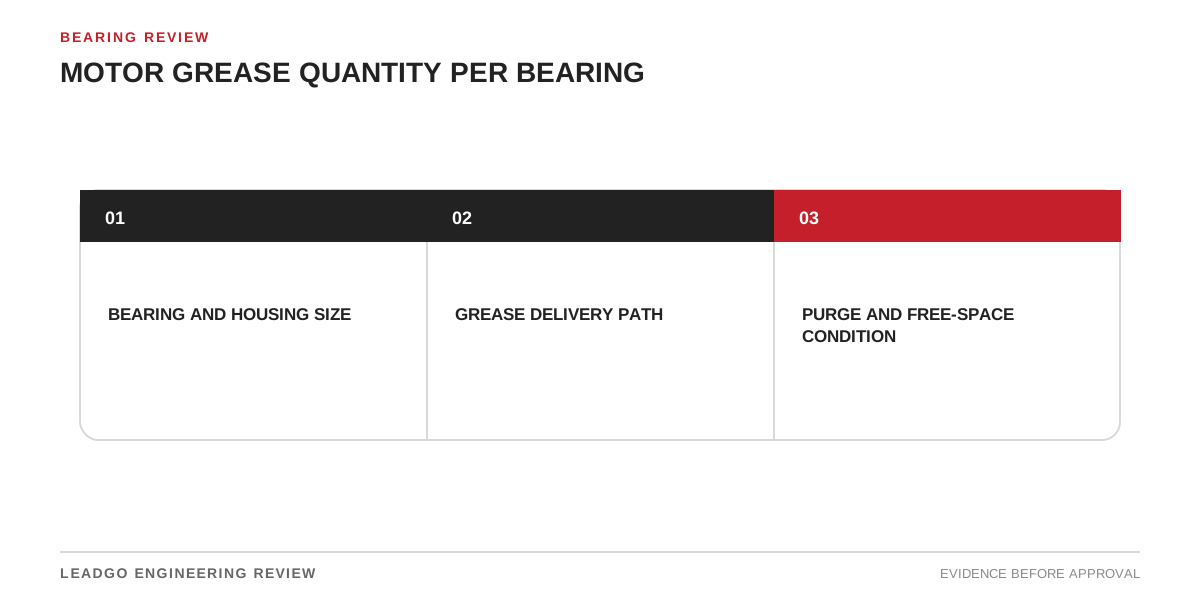
Relubrication instructions often fail at the point where grams become strokes. The nameplate may identify a grease type and interval while the workshop uses a different gun, the wrong fitting or a blocked drain. A useful instruction connects the specified quantity to the actual housing and field method.
One row for each bearing position
| Field | Drive end | Non-drive end | Why it matters |
|---|---|---|---|
| Bearing designation | Record exact bearing | Record exact bearing | Prevents assumptions based on frame size |
| Housing and free-space basis | Identify arrangement | Identify arrangement | Influences fill and purge behaviour |
| Grease product | Manufacturer and designation | Manufacturer and designation | Controls compatibility and performance |
| Relubrication amount | Mass per event | Mass per event | Keeps the instruction measurable |
| Site-gun conversion | Verified mass per stroke | Verified mass per stroke | Converts the instruction without guessing |
| Drain/purge state | Required position and duration | Required position and duration | Provides a path for displaced grease |
| Operating condition | Running or stopped as specified | Running or stopped as specified | Avoids unsafe or ineffective application |
Do not derive a field quantity solely from motor power. Bearing size can support screening calculations, but the motor manufacturer’s housing-specific instruction and project duty remain the governing basis.
Verify that grease reaches the bearing
Trace the fitting, pipe and passage to the intended bearing. Look for damaged extensions, hardened grease, crossed lines or a drain that has been painted shut. Where the approved procedure calls for purging, record whether old grease exits and whether its condition suggests contamination or incompatibility.
Temperature after relubrication should be interpreted against load, speed and previous trend. A sustained rise is a reason to review quantity, purge and compatibility, not a reason to add more grease automatically.
Make the maintenance instruction usable
- State quantity by mass and the verified site conversion.
- Keep separate drive-end and non-drive-end entries.
- Identify grease product and compatibility review when changing products.
- Record date, running hours, amount delivered and drain observation.
- Escalate blocked paths, abnormal purge material or sustained temperature change.
Quantity and interval are separate decisions. Use Motor Grease Relubrication Intervals for duty and environment, and Grease Compatibility before mixing products.