
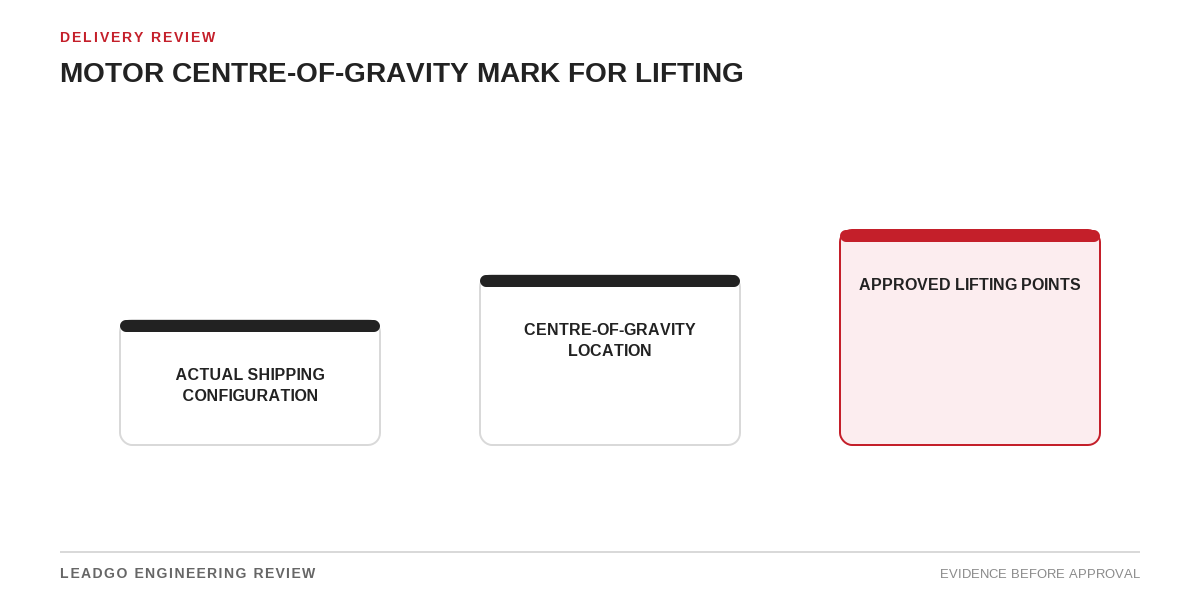
A motor’s centre-of-gravity mark is useful only when it represents the configuration being lifted. Identify whether the mark applies to the bare motor, an assembled motor or the complete packed crate. Keep it connected to the approved lifting points, package orientation and handling instructions. A mark copied from a catalogue outline can mislead a rigger when accessories, skids or loose items change the load.
For a shipment review, send the motor outline, packing arrangement and proposed lifting marks. Include the motor tag, crate number, accessories attached or packed separately, and the latest handling drawing. That allows the supplier and buyer to reconcile the marked load with the object that will actually be picked.
Boundary: package marking is not a lift plan
This article covers the information needed on shipping drawings and crate marks. It does not design a lift, select sling capacity, prescribe rigging geometry or authorize personnel to handle a load. Those decisions belong to competent people using the site or carrier’s approved lifting plan, the actual load, lifting equipment and applicable local rules.
OSHA’s sling requirements address inspection, use and safe working load markings for slings in its regulatory scope. HSE’s lifting operations guidance explains planning and supervision under UK requirements. These sources support careful identification and planning; they do not define a universal centre-of-gravity label design for motor crates. Follow the applicable jurisdiction and contract.
A crate can have lifting points that differ from the motor’s own lifting eyes. A motor may also have instructions limiting which eyes may be used, or requiring components to be lifted separately. Keep those cases explicit. Do not assume the package lifting arrangement inherits the motor manufacturer’s lifting instructions.
Define the configuration before placing the mark
Start from the shipping configuration record. List the motor, cooler, terminal box orientation, accessories, coupling components and any separate cases. State which items are attached, secured inside the crate or shipped separately. The drawing should make clear what mass and geometry the centre-of-gravity symbol describes.
Distinguish an estimated location from a verified one. If the supplier uses a calculation, record its source configuration and revision. If a physical weighing or balance method supports it, retain the method and measured assembly identity. Do not imply accuracy beyond the evidence. The shipping mark is operational information, not a substitute for a load calculation.
The configuration can change after the mark is produced. A removed accessory, relocated crate support or revised skid may alter the package balance. Establish a change trigger that requires the mark and drawing to be reviewed again before dispatch.
Shipment lifting-mark control worksheet
Use this worksheet to connect equipment identity, package design and visible marks. The fields are an original procurement aid; they are not a prescribed regulatory label.
| Check | Record or drawing evidence | Release question |
|---|---|---|
| Equipment identity | Motor tag, model, serial or order reference | Is the marked load the correct unit? |
| Package identity | Crate number and packing revision | Can the mark be tied to this specific package? |
| Configuration included | Attached parts and separate cases | Does the centre-of-gravity basis match the packed contents? |
| Mass basis | Declared package mass and source | Does the value describe the packed unit, not the bare motor? |
| Centre-of-gravity basis | Calculation, drawing or measurement record | Is the estimate or verification method identified? |
| Lifting-point identity | Package lugs, base slots or motor lifting devices | Which physical points are approved for this handling stage? |
| Orientation | Top, drive end, terminal-box side and tilt limits | Can handlers orient the crate without guessing? |
| Mark visibility | Position and durability of symbol on crate faces | Will the mark remain visible after stacking or wrapping? |
| Handling restrictions | Separate lifts, prohibited points or sequence | Are restrictions readable before rigging is attached? |
| Revision and sign-off | Drawing revision, checker and release date | Did the approved mark survive the final packing change? |
Show the centre-of-gravity symbol in more than one view when the load may be approached from multiple faces. The drawing should distinguish it from the package midpoint and from lifting points. State the symbol legend and units used for any coordinate dimensions. Never rely on colour alone if the mark can be obscured, weathered or copied in monochrome.
If the package contains a loose accessory case, identify whether it is included in the marked load. A case tied to one end of the skid can move the balance; a case shipped separately should not be counted twice. The packing list and drawing should tell the same story.
Decision steps before approving shipment marks
- Freeze the equipment and packing configuration that the shipment drawing covers.
- Identify which lifting points apply to the crate and which instructions apply to the bare motor.
- Review the centre-of-gravity evidence and its stated basis with the responsible packaging or lifting specialist.
- Check that the mark, orientation arrows and restrictions are visible on the actual crate faces.
- Confirm that loose accessories and separate cases are included or excluded consistently across the record.
- Reopen the review if packing, attachments or supports change after marking.
- Transfer the approved handling drawing and restrictions to the carrier and receiving site.
If package dimensions or lifting points change after approval, retain the former drawing as superseded and issue the replacement clearly. A handwritten correction on one side of the crate may not reach the carrier’s planning team or the site that receives it.
Worked review: an accessory case moved after marking
Imagine a hypothetical motor package whose centre-of-gravity mark was approved with an accessory case secured at the drive-end side. During final packing, the case is moved to the opposite side to improve space use. No actual weight, distance or shift is assumed here.
The packer records the revised location and alerts the shipping coordinator. The reviewer checks whether the original mark remains valid for the changed package. If the existing evidence cannot establish that, the supplier updates its basis and mark before dispatch. The crate identity remains the same, but the packing revision changes.
The receiving team receives the revised packing list and mark drawing. This avoids asking handlers to infer balance from appearance or assume that the crate resembles a previous shipment. The scenario demonstrates a control point; it does not supply rigging calculations.
Common mistakes in lifting-mark documentation
One common mistake is using the motor’s centre of gravity for the crate. The package includes the skid, restraints, weather protection and possibly loose parts. Each configuration needs its own stated basis.
Another is assuming a lifting eye is approved for any orientation. Use the motor manufacturer’s instructions for the exact lifting arrangement and distinguish those points from crate lugs designed for transport. Do not create new lifting use from the presence of a welded feature.
Marks placed where a fork pocket or strap hides them are hard to use at the moment they matter. Review the actual packing layout and ensure handling instructions can be read before the load is disturbed. Photograph the finished package as part of dispatch evidence.
Finally, a generic “lift here” symbol does not explain whether a crossbar, spreader, or separate lift is required. Refer the detailed method to the approved lift plan and make sure the packaging drawing does not contradict it.
Supplier information and dispatch handover
Request the final packed configuration drawing, declared gross mass and dimensional record, centre-of-gravity basis, lifting-point identification, restrictions and photographs of the marked crate. Ask the supplier to state who reviewed the handling data and which packing revision it covers.
The export packaging and storage guide addresses broader transport protection, while the motor shipping damage and receiving inspection guide helps the receiving team document package condition. Include lifting-mark evidence in the dispatch record where the purchase scope requires it.
Before release, confirm the receiving team can identify the package and access the current handling drawing. Retain any change notice and superseded mark. That record provides a sound starting point for receiving and future shipment planning without replacing the actual lift plan.