
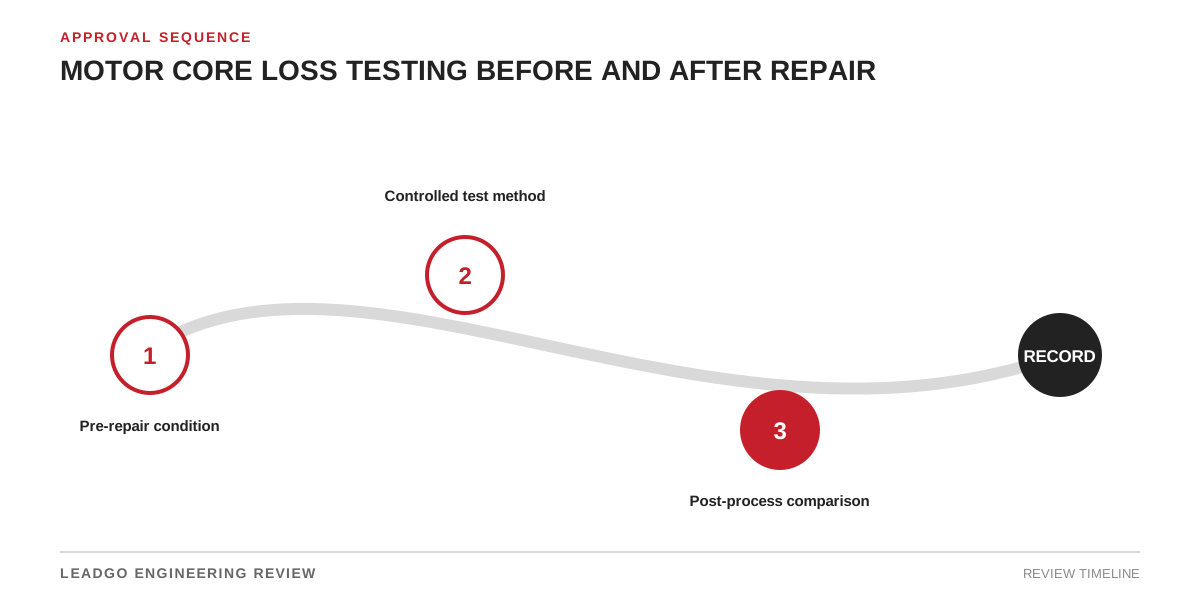
Removing a winding can expose or create damage in the stator iron. Excessive heat, mechanical force, burrs between laminations and poorly controlled local repairs can increase eddy-current paths. The purchasing question is therefore not simply whether a workshop performed a core test. It is whether the test can demonstrate what changed.
Build a comparison that can be repeated
| Record item | Before stripping | After stripping or repair | Why it belongs in the report |
|---|---|---|---|
| Test method and equipment | Identify method and instrument | Use the same method or explain the difference | Prevents unlike results being compared |
| Excitation and duration | Record applied condition | Repeat the documented condition | Makes thermal response comparable |
| Initial core temperature | Record starting temperature | Record starting temperature | Separates test heating from a warm starting point |
| Overall result | Retain raw value and units | Report change as well as final value | Shows whether the process altered the core |
| Local hot spots | Map position and temperature rise | Revisit every mapped area | Finds concentrated damage hidden by an average |
| Corrective work | Note existing damage | Describe repair and retest | Connects disposition to evidence |
Photographs should identify slot or circumferential position rather than show an anonymous red patch. If the two tests use different equipment, the repairer should explain how comparability was preserved.
Separate screening from acceptance
Different core-test methods do not produce interchangeable numbers. A low-flux screening result, a loop test and a proprietary instrument may each be useful, but the report must state the method, calibration status, coverage and acceptance source. A single value copied from another machine is not an acceptance criterion.
Local indications deserve their own disposition. Record whether the area was cleaned, deburred, insulated, separated, repaired or rejected, then repeat the relevant inspection. Do not average a hot spot away.
Release points for the rewind
- Do not strip until the incoming condition and baseline have been recorded, unless the failure condition makes the test unsafe or impossible; document that exception.
- Do not install the new winding while unexplained hot spots or damaged teeth remain open.
- Do not close the repair file without the final map, test conditions, corrective actions and approval.
Core condition is one part of the repair decision. Pair it with the rewind-versus-replace review and keep efficiency conclusions tied to the complete repaired motor, not the core test alone.