
Starting review remains open until motor inertia, load inertia and acceleration time use the same reference. A review that records only the final number leaves the source, condition and responsibility unclear; the motor-inertia RFQ record must identify this boundary explicitly.
Set the boundary before choosing a value — motor-inertia RFQ
Selection work is strongest when the load, environment, electrical supply and mechanical interface are reviewed as one package; the motor-inertia RFQ record must identify this boundary explicitly. Catalogue ratings are a starting point; the purchase decision still needs a project-specific duty boundary and a controlled list of deviations; the motor-inertia RFQ record must identify this boundary explicitly.
State the duty, site condition and equipment boundary before comparing options. Keep the model and document revision with manufacturer data; identify the engineering owner and operating case for plant inputs; the motor-inertia RFQ record must identify this boundary explicitly.
Three checks that control the answer — motor-inertia RFQ
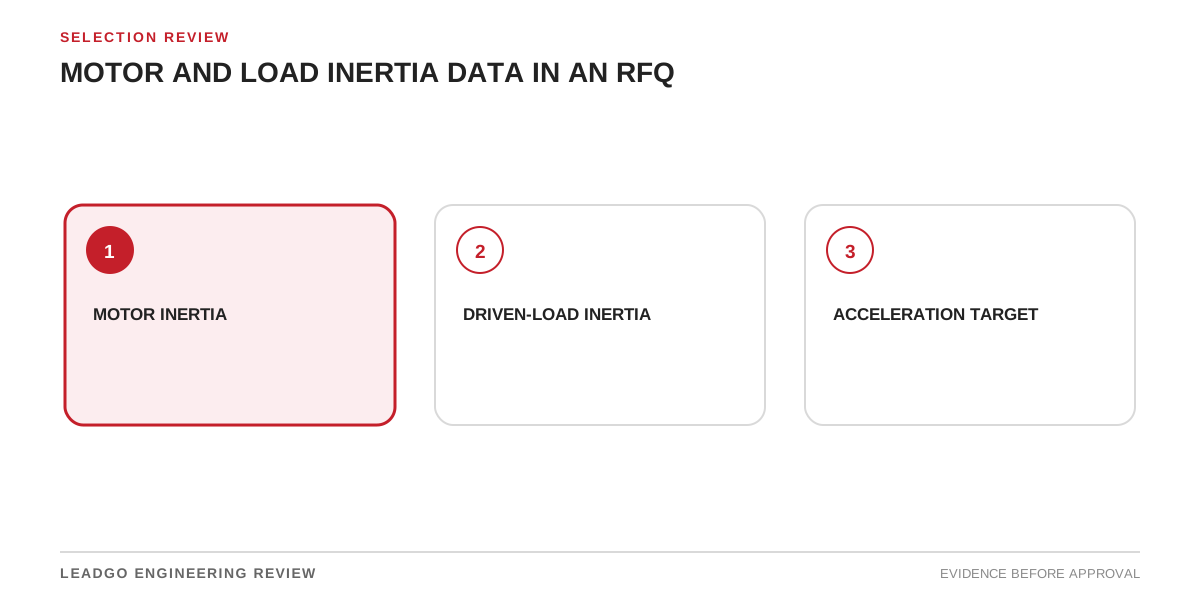
| Step | Review point | What to confirm |
|---|---|---|
| 1 | Motor inertia | Define motor inertia and identify the controlled document or measurement that supports it. |
| 2 | Driven-load inertia | Confirm driven-load inertia under the stated operating condition rather than a nominal assumption. |
| 3 | Acceleration target | Record acceleration target with its source, revision and responsible reviewer. |
Read the three items together. A change at one boundary can move stress into the supply, controls, bearings, cooling system or driven equipment; record that trade-off with the decision; the motor-inertia RFQ record must identify this boundary explicitly.
Where the review often fails — motor-inertia RFQ
- Borrowing an unverified input. Using motor inertia from a similar motor or site. A similar frame or power does not prove that the operating boundary is the same; the motor-inertia RFQ record must identify this boundary explicitly.
- Treating an interface as a late detail. Closing the review before acceleration target is documented. That moves an unresolved interface into manufacture, installation or commissioning.
If an input is unavailable, request the exact drawing, calculation, test result or site measurement needed to close it; the motor-inertia RFQ record must identify this boundary explicitly. A visible open action is safer than a borrowed number.
Keep a usable project record — motor-inertia RFQ
Keep these items with the approval or maintenance record:
- source and operating condition for motor inertia
- dated evidence for driven-load inertia
- approved limit or disposition for acceleration target
The record should show revision, date, reviewer and open assumptions. Photographs and field notes can support the decision, but controlled drawings, calculations and test reports remain the governing evidence where specified; the motor-inertia RFQ record must identify this boundary explicitly.
Decision rule — motor-inertia RFQ
Starting review remains open until motor inertia, load inertia and acceleration time use the same reference. Apply that rule across the full operating envelope. If evidence is missing, name the document, measurement or responsible party required before manufacture, shipment, installation or energisation; the motor-inertia RFQ record must identify this boundary explicitly.
Going deeper — motor-inertia RFQ
- Electric Motor RFQ Checklist: What Buyers Should Specify.
- How to Read an Electric Motor Performance Curve.
Put every inertia on one shaft reference — motor-inertia RFQ
An inertia value is incomplete without units, component scope and reference speed. For a component connected through a speed ratio, refer its inertia to the motor shaft before combining it. Using angular speeds:
J_referred = J_load × (ω_load / ω_motor)²
The ratio must match the actual gearbox or belt arrangement. Include coupling halves, gear elements, pulleys, fluid or product mass where they materially participate. State whether reported motor inertia includes rotor-mounted accessories.
If a load component has inertia of 80 kg·m² and rotates at half motor speed, its motor-shaft-referred inertia is 80 × 0.5² = 20 kg·m². Adding the unconverted 80 would overstate that component by a factor of four. This illustrates the method only; project calculations require verified units, ratios and components.
Acceleration-segment worksheet — motor-inertia RFQ
| Speed segment | Motor torque input | Load torque input | Referred inertia | Time contribution | Check |
|---|---|---|---|---|---|
| Breakaway to low speed | Offered curve at predicted terminal voltage | Static/breakaway condition | Motor plus participating load | Supplier calculation | Positive margin and no stall |
| Low to mid speed | Same voltage/start basis | Torque-speed curve | Same reference | Supplier calculation | Current limit does not restrict acceleration |
| Mid to near rated | Pull-up/available torque | Process curve and valve/damper state | Same reference | Supplier calculation | Margin through minimum-torque region |
| Final settling | Control transition | Operating torque | Relevant train | Supplier calculation | Stable transfer without excessive overshoot |
For direct-on-line starting, the power-system study must provide credible motor-terminal voltage during acceleration, not nominal bus voltage. For a soft starter or VFD, include current and torque limits. Motor and load curves must use the same case.
RFQ fields that prevent ambiguity — motor-inertia RFQ
Issue load inertia by component, units and reference shaft; load torque versus speed for each condition; breakaway torque; product loading; starts and hot/cold sequence; allowable acceleration time; gearbox ratio; and starting method. Mark missing values as open queries rather than zero.
Require bidders to return rotor inertia, speed-torque/current curves, assumed terminal voltage, acceleration by segment, thermal margin, permitted starts, maximum load inertia on the stated basis, and restart restrictions. A statement that the motor “can start the load” is not an engineering deliverable.
Decision sequence — motor-inertia RFQ
- Freeze mechanical configuration and speed reference.
- Reconcile units and convert all load inertias to the motor shaft.
- Select credible start cases such as cold viscous load or full conveyor.
- Establish terminal voltage or drive current/torque limit.
- Compare torque across speed, calculate time and check thermal limits.
- Coordinate protection so an allowed start is not tripped while a failed start is cleared.
- Record sensitivity to uncertain inertia, torque and voltage.
Applicability and limitations — motor-inertia RFQ
This supports systems where motor and load torque-speed data can be stated. High-inertia, reciprocating, cyclic or torsionally sensitive trains may need transient and torsional analyses. The simple conversion does not model backlash, flexible shafts, fluid transients or resonance.
Do not use a curve from a different motor design as final evidence. Offered-motor tolerances and supply variation need review. An unloaded factory run does not demonstrate site-load acceleration.
Common RFQ errors — motor-inertia RFQ
- Giving inertia without speed or shaft reference.
- Mixing inertia units without controlled conversion.
- Omitting gearbox/coupling contributions or counting them twice.
- Using running shaft power instead of breakaway torque.
- Checking time but not permissible starts and thermal condition.
- Comparing bids at different terminal voltages or start methods.
Closeout evidence — motor-inertia RFQ
The accepted study should identify motor and load revisions, curves, units, reference shaft, start cases, voltage/control assumptions, protection limits and reviewer. At commissioning, capture current and speed versus time for a representative load. Reconcile differences with the study rather than simply changing protection. Preserving that comparison gives operations a defensible baseline for later process changes or heavier product.
Bid comparison questions — motor-inertia RFQ
Use the same questions for every bidder. Which shaft is the stated inertia referred to? Which rotating components are included? What terminal-voltage profile was used? Which load torque curve and process condition govern? Where is the lowest accelerating-torque margin? How many starts are permitted from cold and hot conditions? Which protection limit ends a failed start?
Require bidders to mark assumptions directly in the returned worksheet. If one proposal assumes an unloaded pump while another models a viscous cold start, their acceleration times cannot be ranked as equivalent. Reissue a common clarification case and require both calculations to be updated.
The purchase recommendation should distinguish a compliant calculation from a robust design margin. Record sensitivity for load inertia, voltage and breakaway torque so the project knows which late process change would force a motor or starting-system review.