
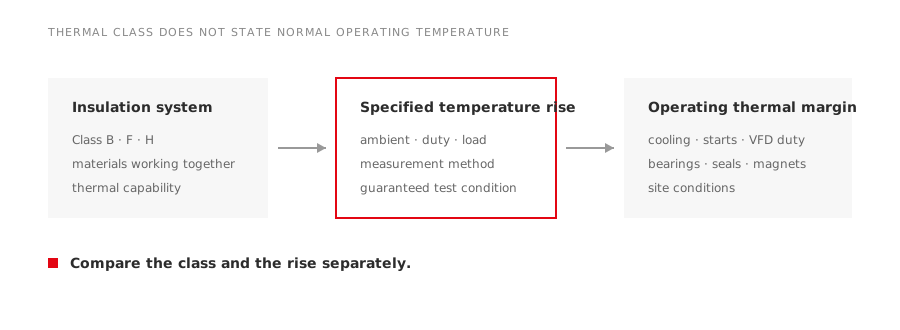
“Class F motor” is incomplete shorthand. It can describe the insulation system, the permitted temperature rise, or both. Those are different statements, and the difference matters when two quotations appear to offer the same motor.
Direct answer
Thermal class describes the temperature capability assigned to an insulation system. It does not tell you the temperature at which the motor will normally run. To compare motors, put five items on the same line:
- insulation thermal class;
- winding temperature-rise limit;
- reference ambient temperature;
- duty and load condition;
- temperature-measurement method.
A specification such as “Class F insulation, Class B rise” is therefore more informative than “Class F” on its own.
What B, F and H actually classify
The winding insulation is a system of enamel, slot liners, phase separators, tapes, impregnation resin and other materials used together. Its thermal class is not established by pointing to the highest-rated material in the stack.
| Thermal class | What it tells the buyer | What it does not prove |
|---|---|---|
| B | The insulation system has a Class B thermal designation | That the winding will operate at the class limit |
| F | The system has a higher thermal designation than Class B | That temperature rise is also specified to the Class F limit |
| H | The system is intended for a still higher thermal class | That bearings, seals or other components tolerate the same temperature |
The letters are classification labels, not a quality ranking for the complete machine. A well-cooled Class F motor may run cooler than a heavily loaded Class H design.
Temperature rise completes the sentence
Temperature rise is the increase above the stated ambient under defined operating and test conditions. A winding can be assessed by resistance or by embedded detectors; the reported values are not interchangeable without knowing the method.
This is why a buyer should reject comparisons that place “Class F” in one column and “Class B rise” in another without declaring ambient and measurement basis. The arithmetic may look simple, but the contract is in the test conditions.
LEADGO’s separate guide to Class F insulation with Class B rise explains that common specification in detail. The practical point is thermal margin: the insulation system has a higher class than the specified rise uses. That margin can help accommodate manufacturing variation and service conditions, but it must not be converted into an unofficial overload allowance.
Why a hotter class is not always the answer
Raising the insulation class does not remove the original heat source. If the motor is hot because of voltage unbalance, blocked ventilation, excessive starts, overload, harmonic current or a poor mechanical load, specifying Class H can hide the symptom while other components continue to age.
Bearings and grease have their own temperature limits. Permanent magnets can have irreversible-demagnetisation limits tied to grade, rotor temperature and magnetic operating point. Encoder electronics, terminal materials, seals and the driven equipment may also be less tolerant than the winding system.
The better question is: why is the expected winding temperature high, and which component becomes limiting first?
Ambient temperature changes the available margin
Motor ratings are declared against stated site conditions. High ambient temperature, altitude, restricted airflow, radiant heat and frequent starting can all alter the thermal result. A motor intended for an indoor pump room cannot be assumed to keep the same output beside a kiln or inside a poorly ventilated enclosure.
Ask the supplier to state any derating or design change for:
- maximum and minimum ambient temperature;
- installation altitude;
- indoor or outdoor exposure;
- cooling-air contamination;
- starts per hour and acceleration time;
- VFD speed range and constant-torque duration;
- non-standard duty cycle.
Specific derating factors belong to the manufacturer’s verified design data. A generic percentage copied from another motor family is not a safe substitute.
Converter duty needs a separate check
VFD operation introduces steep-front voltage pulses, reflected-wave effects in long motor cables, harmonic heating, reduced shaft-fan cooling at low speed and common-mode bearing currents. Thermal class addresses only part of that package.
For a converter-fed motor, request the permitted supply and switching conditions, cable-length basis, speed range, torque envelope, cooling method and any bearing-protection requirement. If the motor uses an independent fan, confirm its separate supply and interlocking.
A quotation comparison that works
Use a table like this before accepting “upgraded insulation” as a benefit:
| Item | Bid A | Bid B | Evidence required |
|---|---|---|---|
| Insulation-system class | Datasheet or design declaration | ||
| Temperature-rise limit | Guaranteed value and test method | ||
| Reference ambient | Rating conditions | ||
| Duty and starts | Duty designation and load profile | ||
| Supply | Line or converter, voltage and frequency | ||
| Cooling | Cooling code and low-speed provision | ||
| Acceptance record | Routine/type-test scope as applicable |
If one field is missing, the quoted classes are not yet comparable.
Enquiry checklist
- State the driven equipment and load profile.
- Give the real site ambient and altitude.
- Identify line or VFD supply, including cable length.
- Specify duty, starts per hour and acceleration time.
- Ask for insulation class and temperature-rise limit separately.
- Confirm the measurement method used for the guaranteed rise.
- Record cooling method and any independent-fan requirement.
- Check bearings, seals, magnets and accessories for their own temperature limits.