
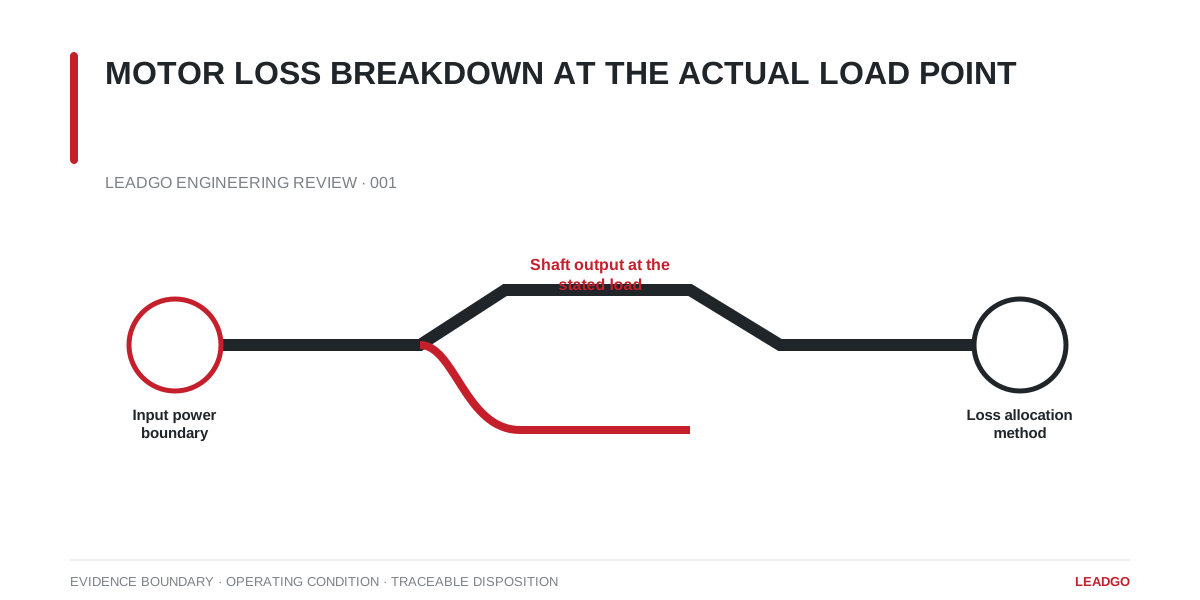
An efficiency figure compresses several physical losses into one number. That is convenient for a catalogue, but it is not enough when a buyer wants to understand energy use at the actual operating point. A motor running at 55% load, for example, does not simply produce 55% of every rated-load loss.
Start with one operating point
Record voltage, frequency, speed, shaft load and winding temperature before examining the loss table. The input power and shaft output must describe the same stabilized condition. If output is inferred from a pump or fan curve while input is measured at another operating point, the resulting efficiency is not a closed measurement boundary.
The temperature basis matters because stator and rotor resistance change as the machine warms. A cold resistance value combined with hot running input can understate load-dependent copper loss.
What each loss term tells you
| Loss component | Main driver | Review question |
|---|---|---|
| Stator copper loss | Current and winding resistance | Was resistance corrected to the stated thermal condition? |
| Rotor copper loss | Load and slip in an induction motor | Does the slip value belong to the same measured point? |
| Core loss | Voltage, frequency and magnetic design | Was it separated using the declared test method? |
| Friction and windage | Speed, bearings and fan arrangement | Is the tested mechanical configuration representative? |
| Stray-load loss | Load-current effects and test convention | Was it measured or assigned according to the cited method? |
This separation helps identify where a proposed improvement can realistically work. More active material may reduce electrical loss, while a different fan can reduce ventilation loss. Neither claim should be extended to loss components it does not affect.
Compare motors without moving the boundary
For a procurement comparison, ask both suppliers for values at the same load points and under the same test standard. Do not compare one motor’s tested efficiency with another motor’s calculated value without labeling that difference. If the driven equipment operates across a duty cycle, calculate input power at each credible load band and weight it by operating hours.
The final decision should retain the source test report, calculation sheet and duty assumptions. That record makes later energy verification possible and prevents a rated-point claim from being reused as a site guarantee.