
For a steady operating point, the power balance is:
Total loss = electrical input power − mechanical shaft output power
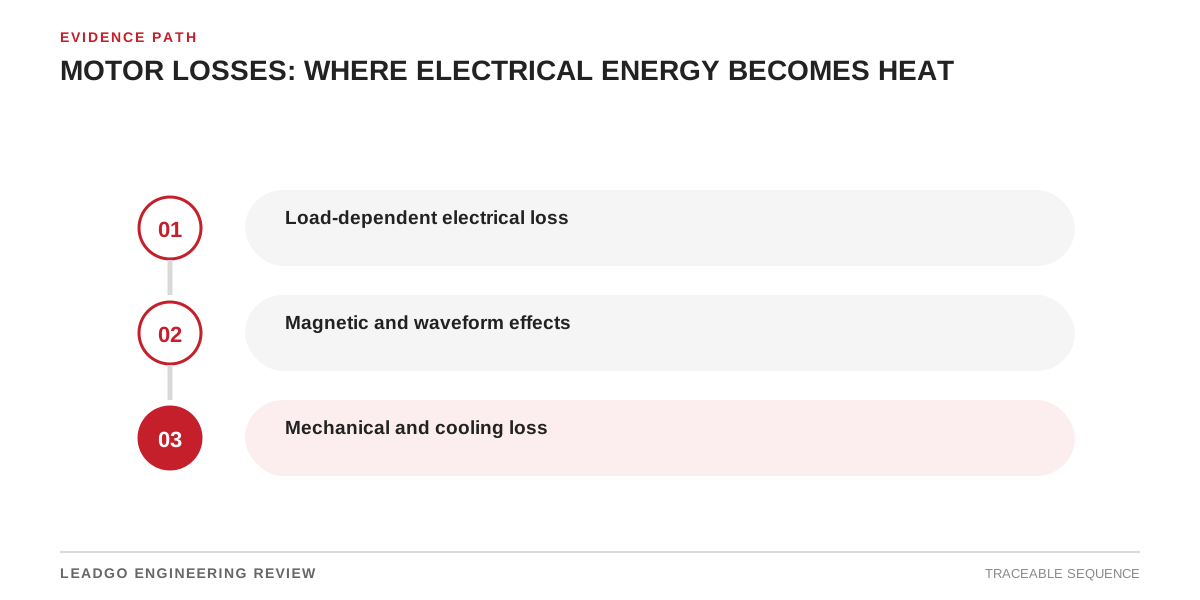
That heat is not one uniform block. Knowing its source explains why a lightly loaded motor, a VFD-fed motor and an overloaded motor behave differently.
| Loss group | Physical source | Main operating influence |
|---|---|---|
| Stator copper | Winding resistance | Current and winding temperature |
| Rotor copper | Rotor current and slip | Load and slip |
| Core | Hysteresis and eddy currents | Voltage, frequency and flux |
| Mechanical | Bearings, seals and fan | Speed and mechanical condition |
| Additional load | Leakage flux/current effects | Load and construction |
Use losses in a purchase decision
Request efficiency at the load points that matter, with test standard, supply condition and whether auxiliaries are included. For annual energy, combine each operating point with hours; do not multiply rated efficiency across the whole year. For VFD duty, assess motor and drive as a system and include any separately powered fan.
A higher measured temperature does not identify the loss source by itself. Diagnose it with current balance, voltage, load, speed, cooling condition and bearing data.
Related reading: motor efficiency classes and lifecycle cost.