
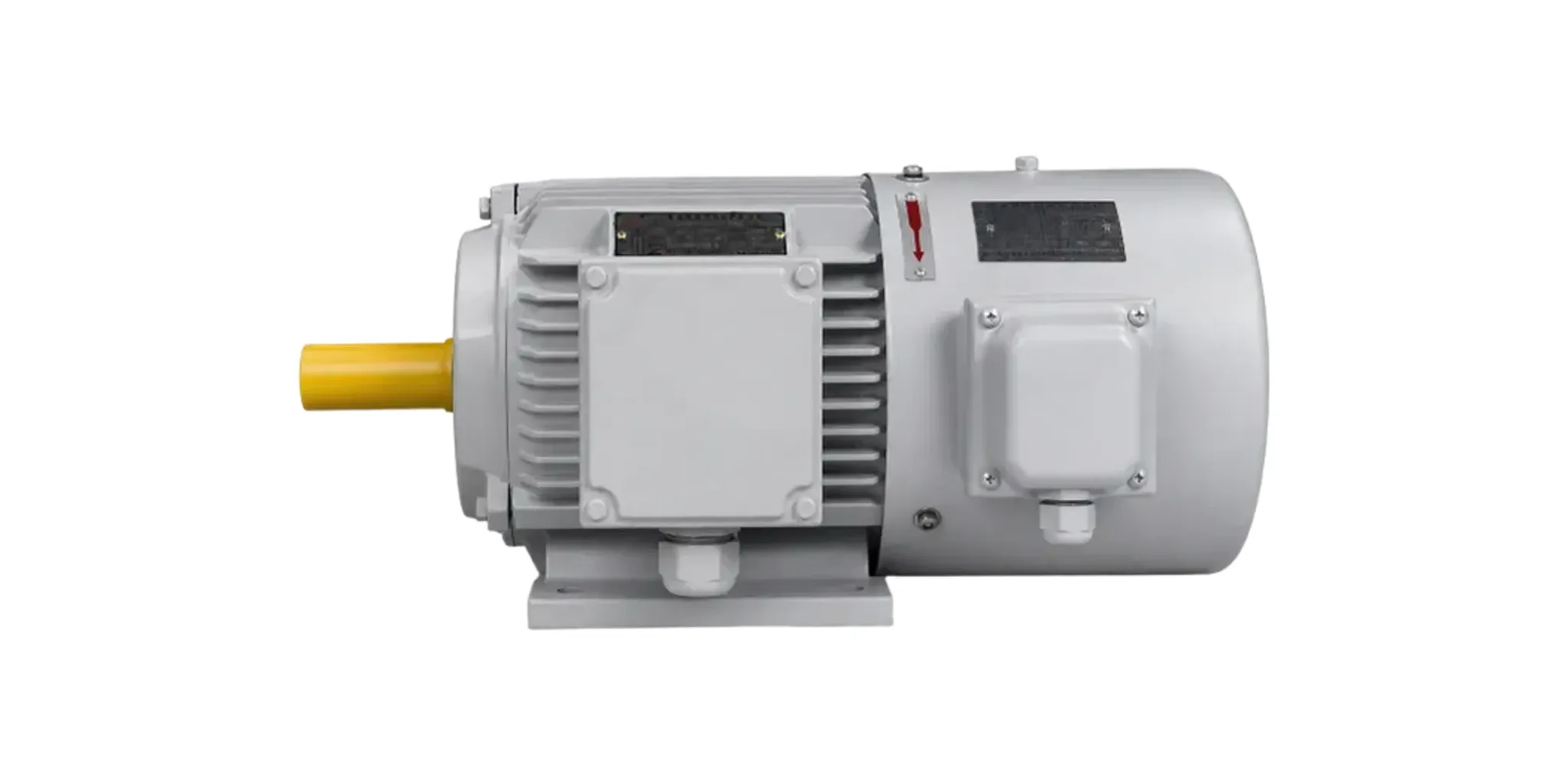
A variable speed installation can arrive carrying three different efficiency classifications, and the one printed largest on the motor nameplate is the one that tells you least about the electricity bill.
Direct answer
Three objects get classified, on two different scales:
| Object | Scale | Where it is defined |
|---|---|---|
| The motor alone | IE1 to IE5 | GB/T 32891.2—2019 (identical to IEC TS 60034-30-2) |
| The converter alone (CDM) | IE | IEC 61800-9-2 |
| The complete system (PDS) | IES0, IES1, IES2 | IEC 61800-9-2 |
The motor standard is unusually blunt about the relationship between them: a high-efficiency motor does not by itself make a high-efficiency power drive system, and the class should be chosen against the actual load point and running hours.
It goes further. Motors that fall outside the motor standard’s own scope — servo machines, for instance — may still be assessed as part of a PDS under IEC 61800-9-2, where the motor and converter together are rated IES0, IES1 or IES2. So “this motor has no IE class” is not the same statement as “this installation cannot be classified”.
These tables are indexed by speed, not by poles
This is the structural difference from line-fed efficiency classes, and it catches people transferring a habit.
Line-operated classes index the reference efficiency tables by pole count — 2, 4, 6, 8 — because a line-fed machine’s synchronous speed follows from its poles and the supply frequency. A variable-speed machine has no such fixed speed, so the tables here are banded by rated speed instead:
- 600 to 900 r/min
- 901 to 1,200 r/min
- 1,201 to 1,800 r/min
- 1,801 to 6,000 r/min
Quote a pole count on a variable-speed enquiry and the class is ambiguous. Quote the rated speed at full-load torque, which is what the table is actually keyed to.
Reference values for ratings not listed, across 0.12 kW to 200 kW, come from the interpolation formula in the standard’s annex rather than from rounding to the nearest row.
Measured at 90% of rated speed, deliberately
The efficiency that determines the class is established at 90% of rated speed, not at 100%. The reason is worth knowing because it explains an apparent oddity in the numbers.
There is a voltage drop across the electronic switches inside the converter. Testing at 90% of rated speed ensures the machine is genuinely at full flux — full voltage — rather than being quietly under-excited by the drive it is being tested with. The standard notes this is consistent with the converter (CDM) requirements in IEC 61800-9-2.
It also notes the consequence: efficiency at 90% of rated speed is normally slightly lower than at 100%, and that reduction is already absorbed into the reduced nominal values, compared with the line-fed figures in IEC 60034-30-1.
So a variable-speed IE number and a line-fed IE number of the same name were not established the same way. Setting them side by side without saying so is a comparison that will not survive review.
The harmonic allowance, and the step at 90 kW
Nominal efficiency limits for IE1 through IE5 are not the reference values themselves. They are the reference values minus an allowance for the additional harmonic losses a converter supply imposes, applied through the standard’s formula.
That allowance is not constant. The additional harmonic factor is:
- 15% at rated output of 90 kW and below
- 25% at rated output above 90 kW
The step at 90 kW is not arbitrary. The standard explains that it reflects a change in the switching frequency of the reference converter defined in IEC TS 60034-2-3. Bigger drives switch more slowly, the harmonic content rises, and the allowance rises with it.
The practical reading: the efficiency class of a converter-fed machine already has a harmonic penalty priced into it, and the size of that penalty changes as you cross 90 kW. A 90 kW and a 110 kW machine at the same class are not carrying the same assumption about their supply.
Efficiency is a range, not a value
Clause 4.3 says something that belongs in every efficiency conversation and rarely appears in one. Motors of the same design vary with material and process, so full-load efficiency for a design is a range rather than a single number. The design is evaluated on its declared efficiency; any individual machine must be not less than that nominal figure minus the tolerance defined in IEC 60034-1.
Which means a measured figure slightly below the published one is not automatically a non-conformity — and a supplier quoting a bare number without its tolerance has not finished the statement.
Two limits worth knowing
- Nothing above IE5. The standard states that efficiency classes above IE5 are not considered.
- Any fundamental frequency. The classification table applies to motors of any fundamental frequency — a real departure from line-fed classes, which are tied to a 50 or 60 Hz supply.
The second point matters when specifying machines for markets on different supply frequencies: for a converter-fed machine, the supply frequency is not part of what defines the class.
What to ask for on a variable speed enquiry
- Which object is being classified — the motor, the converter, or the system. Ask for the scale by name: IE or IES.
- Which part of the standard the motor class comes from. Line-fed classes run to IE4; the variable-speed part includes IE5.
- The rated speed, not the pole count, so the class can be checked against the right table band.
- The efficiency value and its tolerance, not the class alone.
- Whether the system was assessed as a PDS — if energy is the point of the project, IES is the number that describes what you will pay for.
A motor built for inverter duty is a different machine from a general-purpose one run on a drive, and the difference is usually thermal rather than electrical: a shaft-mounted fan slows down with the rotor, so a machine held at low speed under full torque cools itself progressively worse. Separately driven cooling — as on LEADGO’s YVP inverter-duty series — removes that dependency, which is the sort of design detail an efficiency class does not describe on its own.
Going deeper
- GB 18613 and IE classes: reading a Chinese efficiency grade — the line-fed side, and why the two scales run in opposite directions
- Motor duty types S1 to S10 — where part-load and intermittent operation are defined, and why a high class can be the wrong purchase
- NEMA MG 1 explained — how a premium efficiency motor is defined on the US side