
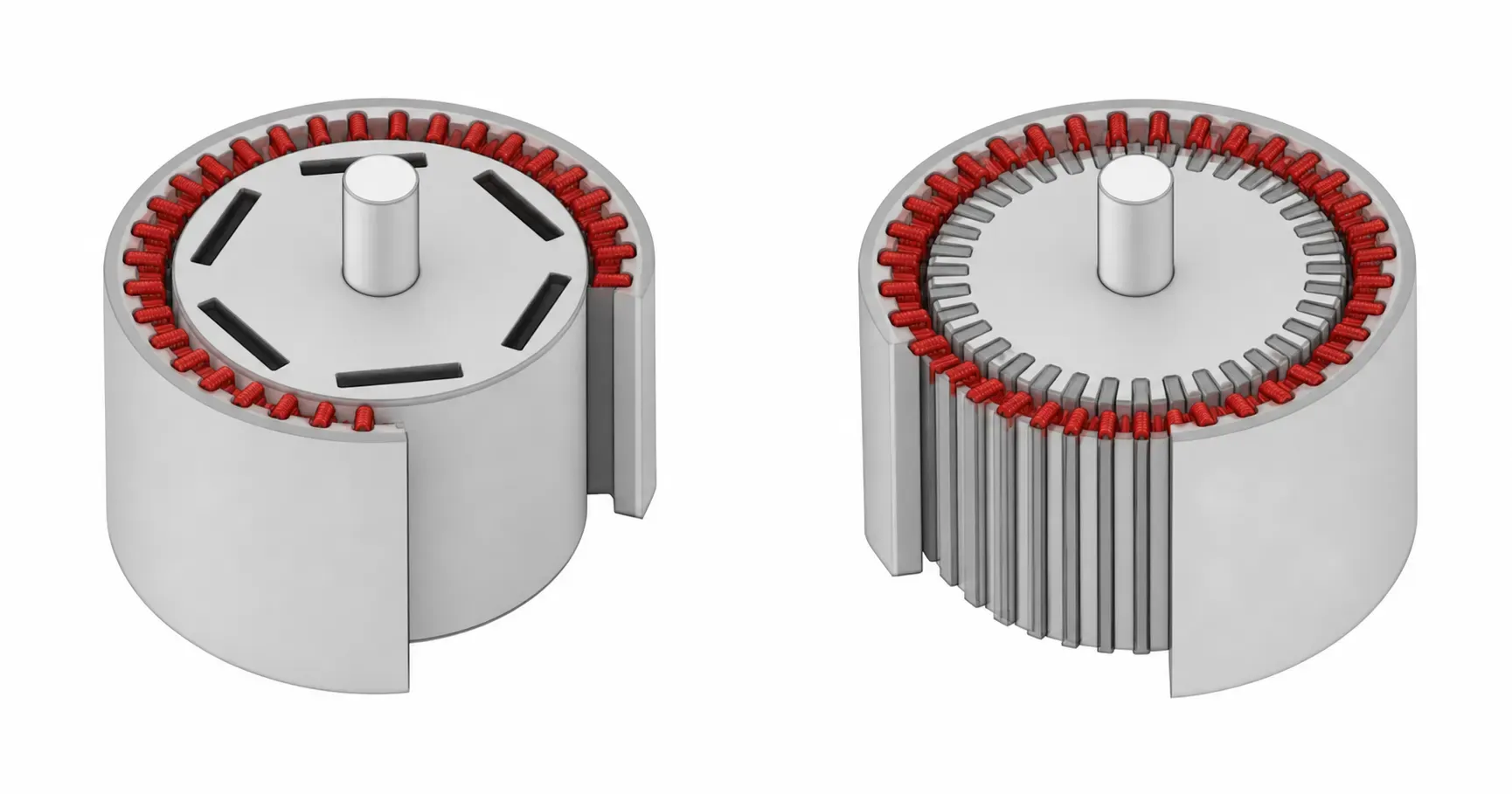
Oilfield equipment rarely runs at its nameplate rating. A beam pump loads the motor heavily on the upstroke and unloads it on the downstroke, so the machine spends its life moving between operating points rather than sitting at one. That single fact decides most of the comparison between permanent-magnet synchronous motors (PMSM) and induction motors in this service.
Where the two technologies actually differ
| Induction motor | Permanent-magnet synchronous | |
|---|---|---|
| Efficiency at light load | Falls off noticeably | Holds above 95% |
| Magnetising current | Required | Not required |
| Rating where the advantage is largest | — | Around 200 kW |
| Very large ratings (>10 MW) | Efficiency still competitive | Better on cost and lead time |
| High-temperature risk | No demagnetisation mode | NdFeB magnets demagnetise above ~150 °C |
| Typical oilfield fit | Water injection and other constant loads | Beam pumps and other variable loads |
The magnetising current line is the one that explains the rest. An induction motor has to establish its rotor field electrically and pays for that whether it is doing useful work or not. A permanent-magnet rotor arrives with its field already there. At full load that overhead is a small fraction of total power; at 30% load it is not.
The 150 °C question
Standard sintered NdFeB magnets have a working temperature ceiling around 150 °C, above which demagnetisation is irreversible. This is a failure mode an induction motor simply does not have, and it is the reason permanent-magnet selection is a thermal question before it is an efficiency question.
Two things follow. First, ambient temperature and cooling arrangement belong in the selection conversation from the start, not as a later check. Second, rotor construction matters: interior permanent-magnet (IPM) rotors tolerate demagnetising conditions better than surface-mounted (SPM) designs, so the rotor topology is worth confirming with the supplier rather than discovering after installation.
What this means for selection
The comparison is not “which technology is better.” It is whether the load varies. If it does — beam pumps, progressive cavity pumps, anything cycling — the permanent-magnet case is strong and should be evaluated against a measured duty cycle. If the load is genuinely constant and the rating is large, the older technologies remain defensible on both capital cost and lead time.
For beam pump sizing specifically, the load calculation comes before the technology choice. That sequence is covered in How to size a motor for a beam pump.