
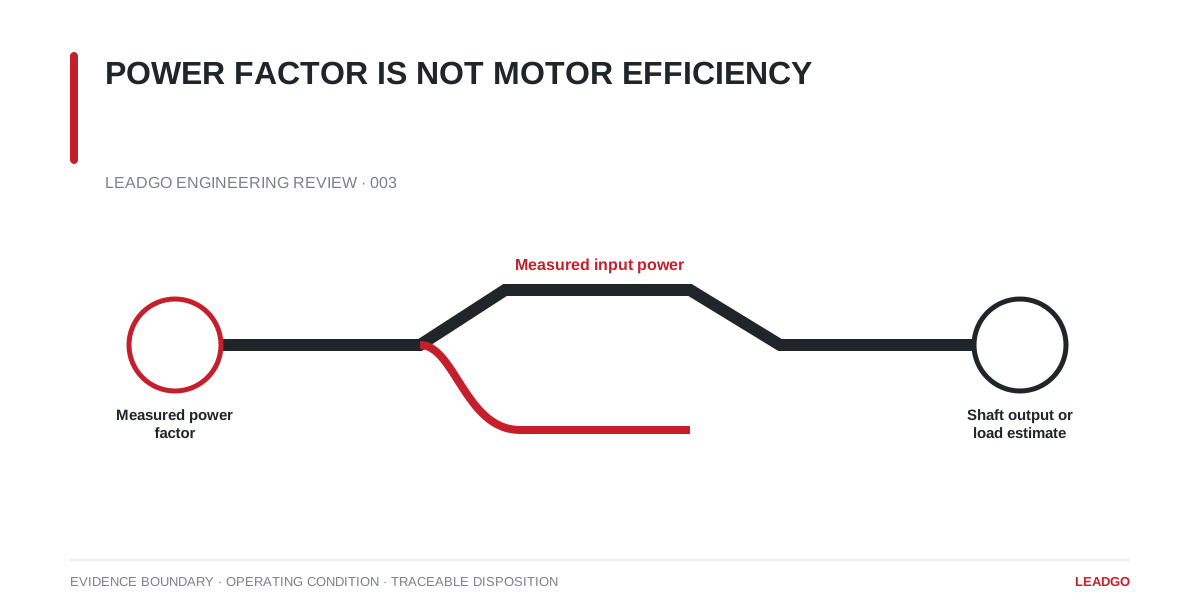
Power factor and efficiency often fall at light load, but for different reasons. Treating them as the same quantity can lead to an unnecessary motor replacement or a capacitor installation that does not deliver the expected energy saving.
Keep the equations separate
Efficiency compares useful shaft output with real electrical input. Power factor compares real input power with apparent power. A motor can therefore have acceptable efficiency and a modest power factor, particularly when the mechanical load is below its design point.
The magnetising current needed to establish air-gap flux does not decline in direct proportion to shaft load. As useful kW falls, that reactive component becomes a larger part of kVA. Power factor can fall even when the motor has no fault.
Read measurements in context
| Signal | What it helps answer | What it cannot prove alone |
|---|---|---|
| kW | Real power drawn | Shaft output or efficiency |
| kVA | Electrical capacity used | Energy converted to useful work |
| Power factor | Relationship between kW and kVA | Internal motor loss |
| Current | Conductor and equipment loading | Mechanical load |
| Speed or slip | Whether the operating point changed | Exact shaft torque |
Confirm whether the reading represents normal production, an idle period or a temporary restriction. A spot reading during light production should not define a replacement decision.
If the motor is consistently oversized, correct sizing may improve both efficiency and power factor. If the issue is a reactive-power penalty, system-level correction may be appropriate after reviewing switching, resonance and harmonics. If the concern is kWh per unit of output, investigate the driven system: throttling, bypass flow and process setpoint can dominate the opportunity.
Judge the result in the unit used to approve the project. Reduced current is not automatically an equal reduction in billed energy; measure kW and process output after the change.