
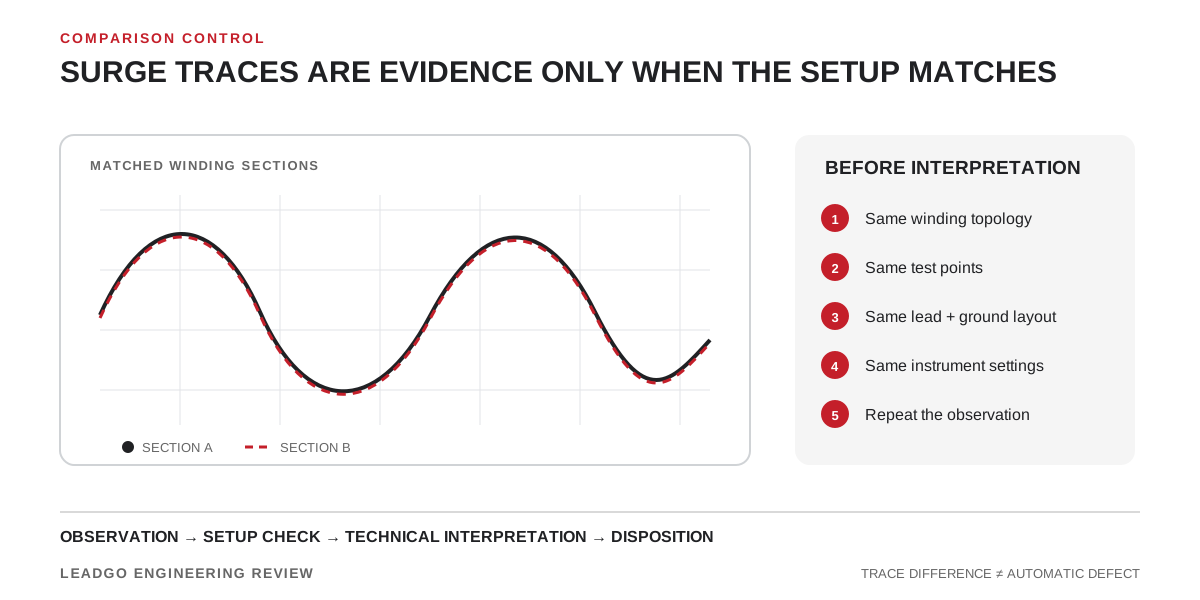
Surge comparison testing is often summarised as “compare the waveforms.” That description leaves out the hardest part: proving that the two traces are entitled to be compared. A difference may reflect turn-insulation weakness, but it can also come from unequal winding sections, internal connections, test leads, grounding or instrument settings.
Confirm that the method fits the winding
IEEE 522-2023 covers the dielectric strength of turn insulation in multiturn form-wound stator coils. Its scope includes individual coils, complete stators, rewind work and certain in-service assessments. The IEEE page also states that the test levels described do not evaluate abnormal voltage surges and that repetitive VFD spikes are outside this guide.
Do not extend that scope automatically to every random-wound motor. For repaired apparatus, use the winding-specific procedure selected by the repair specification. ANSI/EASA AR100-2020 is one recognised repair reference; it also cautions that several factors influence surge results and that pattern interpretation is subjective.
Prove trace comparability
The following matrix turns a visual judgement into an auditable review.
| Comparison control | What must match | What a mismatch can imitate |
|---|---|---|
| Winding section | Coil type, turns, connection and accessible test points | Natural resonant-frequency or amplitude differences |
| Lead arrangement | Lead length, routing, clips and spacing from grounded metal | Added capacitance or inductive coupling |
| Grounding | Frame bond and grounding points | Noise, unstable reference and apparent trace movement |
| Instrument setup | Tester, range, pulse setting, sampling and display scale | Artificial separation or hidden detail |
| Machine condition | Temperature, assembly state and connected components | A change unrelated to turn insulation |
| Test sequence | Step progression, dwell and repeat order | History-dependent differences or operator bias |
When these controls cannot be matched, save the result as an observation rather than labelling a fault.
Read the traces in a repeatable order
Begin at the lowest step required by the approved procedure and verify that the circuit is stable. Compare equivalent sections on the same display scale. If a separation appears, repeat the connection and the measurement before increasing stress. Swapping test leads or repeating the same section can help show whether the change follows the winding or the setup.
Preserve the entire trace set, including results that appear normal. A cropped screenshot of the final display removes the progression that another reviewer needs to reproduce the judgement.
Keep three evidence layers separate
Test observation: what changed in the displayed waveform and at which controlled step.
Technical interpretation: why the reviewer associates that change with the winding rather than the test circuit.
Disposition: whether the governing acceptance procedure calls for retest, investigation, repair or acceptance.
This separation prevents a visual impression from being converted directly into a purchasing or repair decision.
What belongs in the report
The minimum record includes the motor and winding identity, winding diagram, test purpose, applicable procedure, instrument and calibration status, exact test points, lead and ground layout, settings, sequence, saved traces, repeat checks, result and reviewer. If the winding was repaired, retain the winding data and previous test history with the new report.
Do not combine the surge result with a high-potential pass and call the insulation “fully healthy.” The two tests stress and observe different insulation paths, while neither replaces inspection or the other condition evidence required by the maintenance plan.
Release decision
Approve the result only when the method applies to the winding, equivalent sections were compared, setup effects were checked and the disposition follows a named procedure. If those controls are absent, the trace may still guide further work, but it is not sufficient evidence for a final defect declaration.
Related reading: