
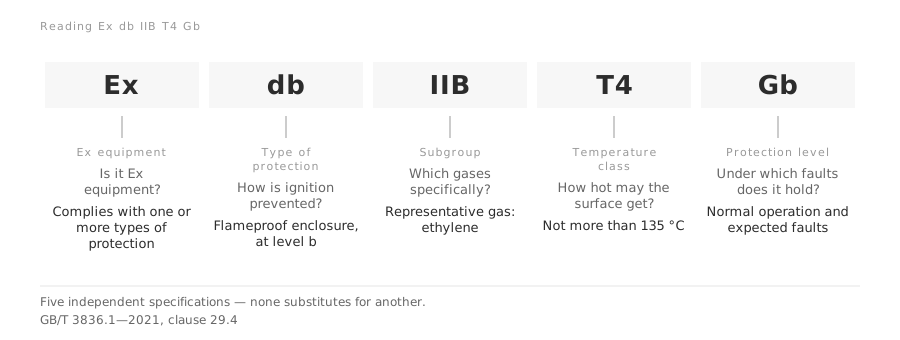
The type of protection in Ex db is one letter, and it describes a mechanism that runs against intuition: a flameproof enclosure does not try to keep the explosive atmosphere out.
Direct answer
It lets the gas in, lets it ignite, and survives the result. The enclosure is built to withstand the internal explosion pressure, and then to stop the flame reaching the atmosphere outside — not by sealing, but by making every escape path narrow enough and long enough that the burning gases cool below the surrounding atmosphere’s ignition temperature before they emerge.
That path is the flameproof joint, and the standard defines it as the surfaces of different enclosure parts that fit together and prevent an internal explosion propagating to the explosive atmosphere around it.
So the gap in a flameproof joint is not a fit. It is the working part of the protection.
Three quantities, and they are not independent
| Quantity | What it is | Which way the limit runs |
|---|---|---|
| Joint width L | The shortest path from inside the enclosure, through the joint, to the outside | A minimum |
| Gap | The distance between the corresponding surfaces, after the enclosure is assembled | A maximum |
| MESG | The largest gap that stops propagation through a 25 mm joint over ten tests | The reference the tables are built on |
Two things follow that catch people out.
The width is a path, not a face. It is measured as the shortest route a flame could take. That is why the standard has separate rules for what happens when fastener holes interrupt the joint — the distance from the joint to the hole edge has its own minimum, stepped by the joint width itself: larger as the joint gets wider.
The gap is an assembled dimension. It is specified after assembly, which means it is not something a drawing tolerance alone can guarantee. Two parts that are each within tolerance can still assemble into a joint that is not.
And the limits are not universal numbers. They come from tables that depend on the gas subgroup and on the enclosure volume — which is why a joint that complies on a IIA machine may not on a IIB one. See gas and dust subgroups for where those groups come from; MESG is the quantity that defines them.
Surface condition is specified, and that is the part people miss
A gap can be within its numerical limit and the joint still be non-compliant, because the standard also governs what the surfaces are like.
Roughness. The mean roughness of the joint must not exceed Ra 6.3 μm. The standard references GB/T 1031 for how that is defined, and notes it may be determined by visual comparison against a reference plate — which tells you this is meant to be checkable on a shop floor, not only in a metrology lab.
No intentional gap. For plane joints other than quick-opening doors or covers, there must be no deliberately created gap beyond what the flatness tolerance of the mating parts produces. You do not get to add clearance for assembly convenience.
Plating has a threshold. Joints may be electroplated. Below 0.008 mm of coating, no additional consideration is needed. Above it, the maximum gap without the coating must still comply, and the flame-transmission test is run at the uncoated dimension. The protection is credited to the metal, not to the plating.
Grease is allowed, conditionally. Rust-preventing grease may be applied before assembly, provided it does not age and harden, contains no volatile solvent, and does not cause the joint to corrode. Suitability is checked against the grease manufacturer’s own instructions.
Put together, these are the reason a flameproof joint cannot be treated as ordinary maintenance. Filing a burr, painting a face, or fitting a gasket where none was certified all change something the certificate covers.
What is different about a motor
A junction box has static joints. A motor has a shaft that turns through one, and the standard adds requirements specifically for rotating machines.
Rolling bearings. For endshields carrying rolling bearings, the maximum radial gap must not exceed two-thirds of the maximum gap otherwise permitted for that joint. The general table limit is not the limit that applies — a third of it is taken away before you start.
Sleeve bearings. These carry a stricter set again:
- The joint width adjacent to the bearing must be at least the shaft diameter, though it need not exceed 25 mm.
- Where a cylindrical or labyrinth joint is used, at least one of the two surfaces must be a non-sparking metal — leaded brass is the example the standard gives.
- The stator-rotor air gap must be larger than the manufacturer’s specified minimum radial clearance, and the non-sparking metal must be thicker than that air gap.
- Sleeve bearings are not permitted in Group IIC rotating machines at all.
There is one more clause worth knowing, because it changes what a buyer should ask for rather than assume:
The standard does not require the manufacturer’s calculated clearance values to be independently verified, and does not require them to be confirmed by measurement.
Those values are declared. That is not a loophole — it is a statement about where the responsibility sits, and it is a good reason to ask which values were declared and on what basis, rather than treating the certificate as covering them.
Why this belongs in a discussion about manufacturing
A flameproof joint is a machining outcome that becomes a safety certificate. The surface finish, the flatness, the bore concentricity and the assembled clearance are all set on the machine tool, and none of them can be recovered by inspection afterwards — inspection can only reject.
That is the general shape of motor manufacturing, and it is why the machining stage sits where it does in the sequence rather than being treated as finishing work.
What to ask for
- The Ex certificate for the exact model and rating, not the family. How to check one.
- The gas subgroup the joints were certified against — IIA, IIB or IIC changes the limits.
- The bearing arrangement, because rolling and sleeve bearings are governed by different clauses, and sleeve bearings are excluded from IIC entirely.
- The maintenance instruction for the joints, in writing: what may be cleaned, what may be greased, and what must go back to the manufacturer.
- Whether any joint has been re-worked since certification — on a used or repaired machine this is the question that matters most.
LEADGO’s flameproof series are built to the flameproof-enclosure standard described here, and the joint requirements above apply to every one of them — the hazardous-area range is where the series and their certifications sit. Ask for the certificate and the joint maintenance instruction together: the first says what was approved, the second says what you are allowed to do to it afterwards.
Going deeper
- Reading an Ex marking — where the
dsits, and the four other segments it does not substitute for - Gas and dust subgroups — MESG is what divides IIA from IIB from IIC, and it is the same quantity the joint tables are built on
- Checking an Ex certificate — certification is per model and per rating
- How a motor is built, stage by stage — where joint machining falls in the sequence