
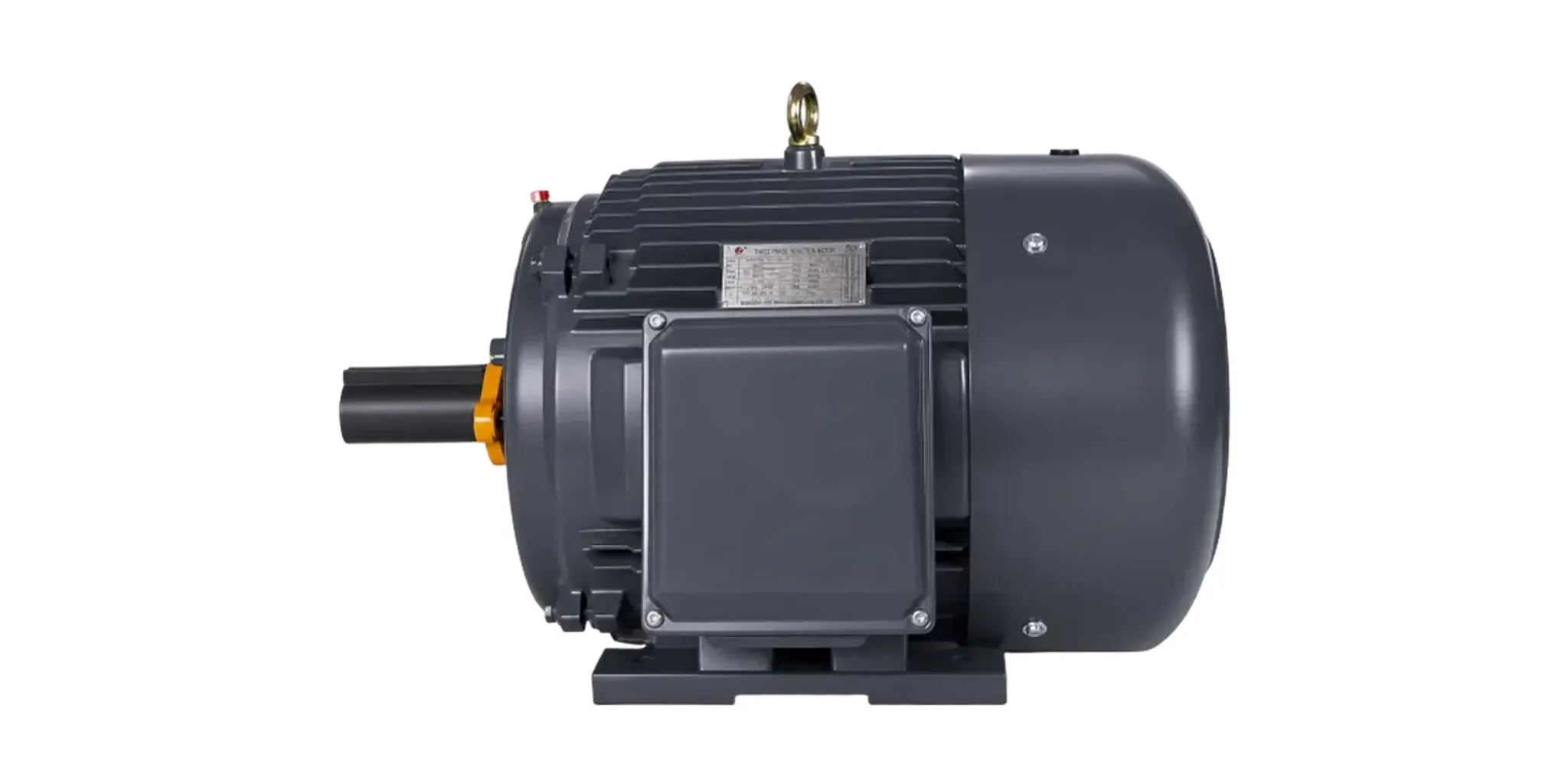
Buyers meet MG 1 as a line in a specification, usually without being told what it is doing there. It is worth knowing, because the standard answers a narrow question very well and a different question not at all.
Direct answer
ANSI/NEMA MG 1 is a voluntary consensus standard, published by the National Electrical Manufacturers Association and approved as an American National Standard. Nothing in it is compulsory by its own force. What makes it matter is that other instruments reference it, and that buyers specify it.
Its job is interchangeability. When a motor is built to MG 1, a set of things about it become comparable — and therefore substitutable — across manufacturers: how it behaves at starting, how much overload it tolerates, what supply variation it must survive, what efficiency level it claims, and how it is enclosed and cooled.
What is actually in it
MG 1 is organised in parts. The ones a buyer touches most:
| Part | Covers |
|---|---|
| 1 | Referenced standards and definitions — including the design letters and service factor |
| 2 | Terminal markings |
| 4 | Dimensions, tolerances and mounting — the frame system |
| 5 | Degrees of protection provided by enclosures — the IP code |
| 6 | Methods of cooling — the IC code |
| 7 | Mechanical vibration: measurement, evaluation and limits |
| 9 | Sound power limits |
| 12 | Tests and performance, AC motors — torques, tolerances, efficiency levels |
| 14 | Application data — including how service factor is actually applied |
| 20 / 21 | Large machines: induction, and synchronous |
| 30 | Application considerations for constant-speed motors on a drive |
Two of those entries surprise people, and we will come back to them.
Five things MG 1 decides for you
1. The design letter. A, B, C, D and the E variants are defined by locked-rotor torque, locked-rotor current and rated slip. This is what makes “Design B” a specification rather than a marketing word — and why oilfield pumping duty has its own letter. We covered that in why NEMA Design D is specified for oil well pumps.
2. Service factor. Defined in 1.42 as a multiplier applied to rated horsepower that indicates a permissible horsepower loading under the conditions specified for it. The conditions are the substance, and they are in Part 14.
3. Supply tolerance. How far voltage and frequency may drift before the motor is out of its stated operating envelope.
4. Efficiency level. 1.41.3 defines a premium efficiency motor as one whose efficiency accords with 12.60 or 20.21C — that is, the level is defined by a table in the standard, not by the word “premium”.
5. Enclosure and cooling. Parts 5 and 6, on which see below.
Service factor is margin, not a second rating
This is the clause most often half-remembered. MG 1 14.37.1 says that a general-purpose AC motor with a service factor per 12.52 is suitable for continuous operation at rated load under the usual service conditions, and that when voltage and frequency are held at nameplate values, it may be overloaded up to rated horsepower multiplied by the nameplate service factor.
Then it says the part that gets left out:
- At any service factor greater than 1, efficiency, power factor and speed may differ from their rated-load values — but locked-rotor torque, locked-rotor current and breakdown torque are unchanged.
- A motor operating continuously at any service factor greater than 1 will have a reduced life expectancy compared with operating at its rated nameplate horsepower. Insulation life and bearing life are reduced by the service-factor load.
So a 1.15 service factor is not fifteen percent of free capacity. It is a defined allowance for excursions, priced in shortened insulation and bearing life if you live there. And note the precondition: the allowance assumes nameplate voltage and frequency. On a site where the supply already sags, the service factor is not sitting where the nameplate says it is.
Supply tolerance: it will run, but not to its numbers
MG 1 12.44.1 requires AC motors to operate successfully under running conditions at rated load with variation up to:
- ±10% of rated voltage at rated frequency, for induction motors;
- ±5% of rated frequency at rated voltage;
- a combined variation of 10%, by sum of absolute values, provided the frequency variation stays within ±5%.
And then, in one sentence that resolves a great many arguments: performance within these voltage and frequency variations will not necessarily be in accordance with the standards established for operation at rated voltage and frequency.
That is the honest reading. The motor is required to keep working. It is not required to keep meeting its published efficiency, power factor, temperature rise or speed while it does. If a site is measuring an efficiency shortfall against a nameplate, the first thing to check is not the motor.
MG 1 carries two IEC systems inside it
This is the part that reframes the usual “NEMA versus IEC” conversation.
Part 5 classifies degrees of protection provided by enclosures — the IP code, with its first and second characteristic numerals.
Part 6 classifies methods of cooling — the IC code. It defines the designation as the letters IC followed by numerals and letters representing the circuit arrangement, the coolant, and the method of moving the coolant, in both a complete form (for example IC8A1W7) and a simplified form (for example IC411). The standard states a preference for the simplified designation, with the complete system intended mainly for cases where the simplified one does not apply.
So a NEMA-frame motor described as IP55 / IC411 is not being specified in a foreign system. Both codes are inside MG 1. The genuine NEMA/IEC divergence sits elsewhere — chiefly in frames and dimensions, in the efficiency tables, and in the design-letter system, which has no direct IEC equivalent.
What MG 1 does not give you
- It does not classify your site. Hazardous-area classification is a separate exercise, done by the facility owner or designer — see who classifies a hazardous area.
- It does not certify a particular motor. Certification against a standard is a conformity-assessment activity; the standard itself is just the yardstick.
- It does not tell you what to buy. It tells you what the words on the nameplate are required to mean, which is what makes comparing two quotations possible at all.
LEADGO builds to MG 1 frames and performance in its NEMA range — including NEMA PE for general industrial duty and NEMA D for oil well pumping. Ask for the rating and design letter against the clause, not the brochure adjective.
Going deeper
- Oil well pump motors: why NEMA Design D is specified — the design letters put to work on a real load
- What TEFC actually means — enclosure type, cooling code and IP rating, and why they are three different statements
- Hazardous area classification: who does it and who carries the risk — the exercise MG 1 deliberately leaves to someone else