
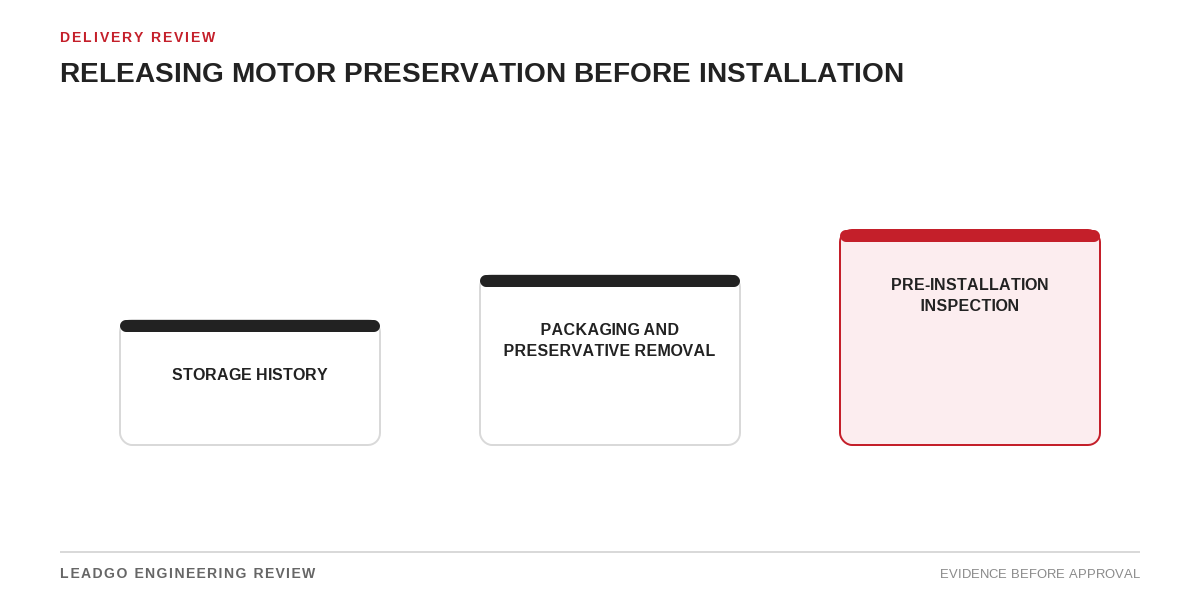
Release a stored motor for installation only after reconciling preservation records with its current condition and the manufacturer’s instructions. The gate matrix below assigns checks for moisture control, restraints, bearings and unresolved exceptions before the installation team takes custody.
For a project-specific enquiry, send storage history, preservation instructions and installation date. Attach the maintenance actions recorded during storage and list any gaps, so release conditions can be discussed before preservation measures are removed.
A preservation release resolves that tension. It confirms that the installation area is ready, reviews the complete storage history and assigns a disposition to each protective measure. The output is a signed condition baseline, not merely an unpacking date.
Applicability boundary for preservation release
Use this process for motors that have been stored after factory release, whether in an export crate, warehouse, laydown area or installed-but-not-commissioned condition. Apply it after long project delays, relocation, packaging damage, environmental excursions or transfer between custodians.
The checklist must follow the specific motor and manufacturer instructions. Bearing type, lubrication system, enclosure, cooling arrangement, space heaters, insulation system and shaft restraint differ. This article does not prescribe universal storage intervals, insulation thresholds or lubricant actions.
Release for installation is also not permission to energise. Installation, alignment, cable work, protection tests and commissioning remain separate gates. A motor can be acceptable for mounting while still carrying open commissioning actions.
Preservation-release gate matrix
Build the matrix from the approved storage instruction and motor arrangement. Record “not applicable” with a reason instead of leaving blanks.
| Release item | Review evidence | Physical action | Hold or quarantine trigger |
|---|---|---|---|
| Motor identity | Tag, nameplate, shipping documents | Confirm unit and accessories | Identity mismatch |
| Storage chronology | Receipt and custody records | Reconcile missing periods | Unexplained custody gap |
| Packaging condition | Dated inspection photographs | Remove in planned sequence | Water entry, puncture or contamination |
| Handling indicators | Receipt and movement records | Preserve evidence before reset/removal | Triggered or missing indicator |
| Storage environment | Temperature/humidity or facility records where required | Compare with instruction | Unassessed excursion |
| Desiccant or humidity control | Inspection/change record | Remove or renew as instructed | Saturation or absent record |
| Space heaters | Supply and functional records | Isolate or retain for next phase | Heater unavailable when required |
| Shaft restraint | Shipping drawing and warning label | Remove at specified stage | Damage, uncertainty or missing parts |
| Shaft/bearing care | Rotation or lubrication record where required | Inspect and perform approved action | Abnormal resistance, noise or leakage |
| Exposed machined surfaces | Preservation record | Clean by approved method and protect until assembly | Corrosion, scoring or unknown coating |
| Insulation condition | Baseline and current test under recorded conditions | Test using approved procedure | Result requires engineering evaluation |
| Terminals and entries | Seals, covers and internal condition | Inspect before cable work | Moisture, contamination or damage |
| Cooling and auxiliaries | Packing list and visual check | Release fans, coolers, sensors and piping | Missing, blocked or damaged item |
| Open preservation deviations | NCR and corrective record | Verify completed disposition | Any unresolved safety or condition issue |
The matrix uses action verbs deliberately. “Checked” does not reveal whether a cover was removed, a heater retained or an item quarantined.
Decision steps for a controlled release
- Confirm that the installation foundation, shelter, lifting route and weather protection are ready.
- Identify the exact motor, accessories and applicable preservation instructions.
- Collect receiving, periodic inspection, custody and environmental records.
- Walk down the package before disturbing it; photograph condition and labels.
- Compare storage history with required actions and list every missed or uncertain control.
- Open packaging in the approved sequence with suitable cleanliness and weather protection.
- Inspect the motor and loose equipment against the gate matrix.
- Perform approved electrical and mechanical checks with test conditions recorded.
- Obtain engineering dispositions for excursions, corrosion, abnormal readings or damaged packaging.
- Remove, retain or renew each preservation measure for the installation phase.
- Mark shaft restraints and temporary devices as removed, or control them on an open-item register.
- Sign the release with motor condition, open actions, responsible party and next gate.
If installation stops after release, define a new preservation state. An opened motor waiting weeks for alignment may need covers, heaters or renewed corrosion protection. The release plan should address this possibility before the crate is opened.
Common errors during preservation handover
Removing all protection at once. Machined fits, terminals and air paths may become exposed before the relevant work starts. Sequence removal by installation need.
Using one good electrical reading as a complete release. Insulation results do not establish bearing, shaft, corrosion, cooling or accessory condition.
Cleaning before documenting. Rust staining, water paths, damaged seals and loose material can show how an issue developed. Record condition before cleaning changes the evidence.
Applying unapproved solvents or abrasives. Cleaning can damage coatings, seals, insulation or certified interfaces. Use the applicable instruction and material compatibility basis.
Forgetting loose-shipped auxiliaries. Fans, coolers, sensors, oil equipment and terminal accessories may be stored separately. Reconcile the complete packing list.
Removing a shaft restraint without controlling the next move. The device may be needed for another lift, or removal may expose the bearing to transport loads. Follow the planned stage and retain parts where instructed.
Backfilling missing rotation or heater logs. A reconstructed checklist does not prove that preservation occurred. Record the gap and perform an engineering assessment.
Leaving temporary covers untracked. Covers, plugs and braces can remain in air paths or terminals. Put every temporary device on a removal register.
Supplier and RFQ requirements for preservation
Ask the supplier for a preservation plan tied to the motor construction, packaging method, route, expected storage duration and climate. It should identify storage environment, inspection actions, shaft or bearing care where applicable, heater use, desiccant treatment, corrosion protection, packaging maintenance and release steps.
Request a shipping drawing that identifies restraints, lifting points, temporary covers and loose-shipped items. Require conspicuous tags for devices that must be removed before rotation or energisation. Ask for approved cleaning materials and re-preservation instructions if installation is delayed after opening.
The RFQ should allocate responsibility for periodic inspection, consumables, site attendance, long-storage extension and condition assessment after an excursion. State required record formats and language. If warranty depends on preservation compliance, align the technical plan with the commercial clause rather than assuming one controls the other.
Test and inspection evidence at release
Record test equipment, date, motor temperature and environmental condition where they affect interpretation. Compare electrical results with appropriate baselines and governing instructions; do not use an isolated universal threshold. Where polarisation, winding resistance, heater, sensor or continuity checks are required, identify the approved procedure and acceptance authority.
Mechanical inspection should cover accessible shaft, bearing, sealing, terminal, cooling and mounting features without dismantling beyond the planned scope. Rotate shafts only when permitted and with the correct restraint and lubrication condition. An unusual sound or resistance is an observation requiring disposition, not a diagnosis by itself.
Photographs should show motor identity and location, not only close-ups. Link each exception to an NCR, site query or punch item. Retain removed labels and indicator evidence when they may support a transport or storage claim.
Installation-release acceptance and closure
Release the motor when identity is confirmed; storage history has been reviewed; required inspections and tests have acceptable dispositions; packaging and temporary devices have controlled actions; loose items are reconciled; and the installation area can protect the exposed machine. Unresolved condition issues require an explicit hold or authorised concession.
The release record should state what preservation remains active. Space heaters, protective covers or corrosion controls may continue until cable termination or commissioning. Assign the next owner and due point for every retained measure.
At handover, provide the signed matrix, photographs, test results, storage history, deviations and temporary-device register. This record becomes the “as received from storage” baseline for installation and commissioning, making later damage easier to locate in time and responsibility.