
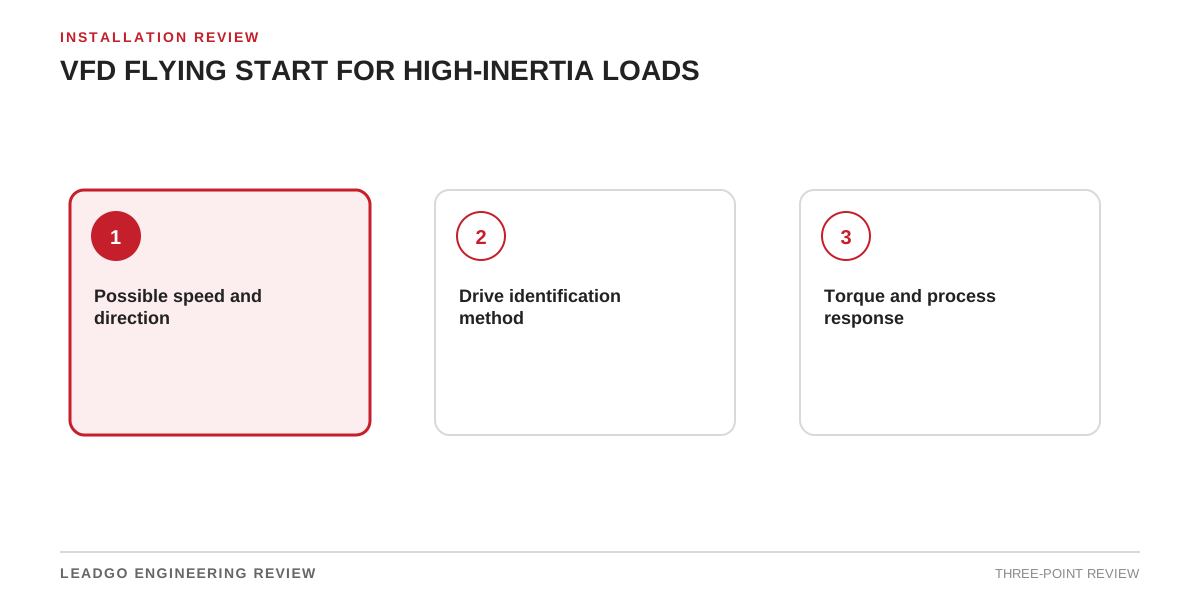
Flying start estimates or detects a coasting motor’s speed and phase before applying torque. High inertia lengthens coast-down, so a restart command can arrive while considerable stored energy remains.
Catch a rotating load without imposing a second start
Confirm whether reverse rotation is possible and whether the process permits catching it. Review contactors, bypass circuits and residual voltage. A generic restart delay does not prove that the motor has stopped.
Restart sequence
| Item | Engineering purpose | Review action |
|---|---|---|
| Coast detection | Actual speed and direction | Set search range |
| Flux establishment | Motor identification data | Avoid current surge |
| Torque pickup | Ramp and load demand | Prevent mechanical shock |
| Safety state | Permissive and STO logic | Do not bypass process safeguards |
Evidence required before approval
Test several speeds and directions under controlled conditions. Trend DC-bus voltage, current, detected speed and torque. Approve only when failed detection leads to a defined safe response.
Retain the equipment revision and test record. Name the reviewer. Keep open assumptions visible.
Commissioning decision
Never approve a copied setting. Confirm interface compatibility and operating limits. Exercise the intended response during a functional test.