
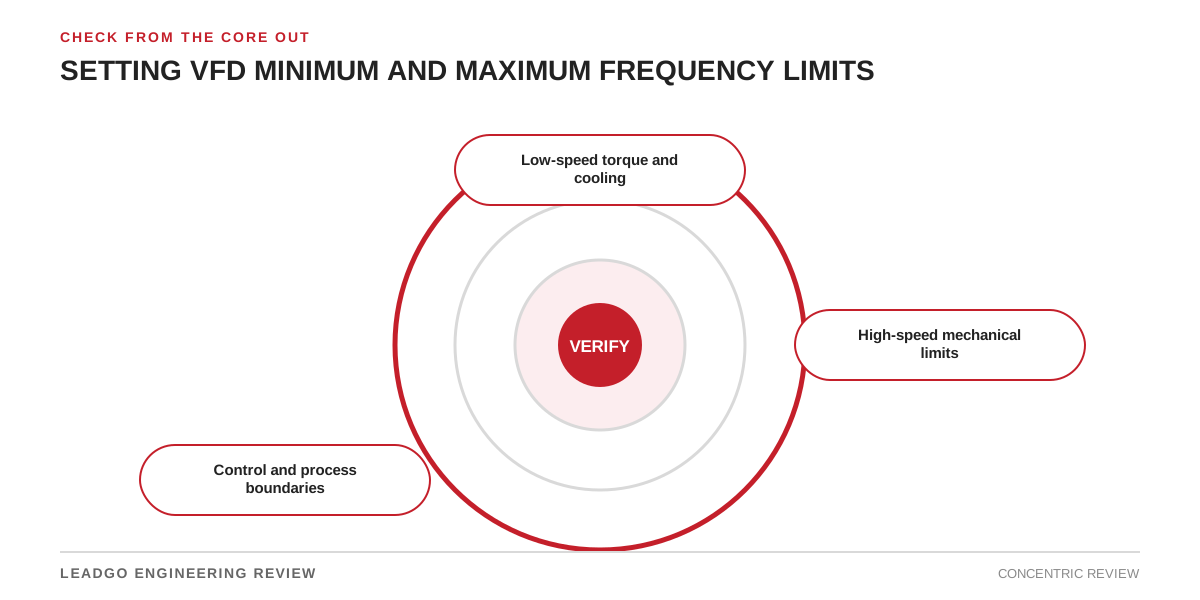
Drive frequency limits are engineering boundaries, not merely operator preferences. Low speed can reduce shaft-driven cooling; high speed can exceed rotor, bearing, fan, coupling or driven-equipment capability.
Set frequency limits from the motor and process envelope
Build one speed-envelope register covering motor, drive, gearbox, coupling and machine. Convert frequency to mechanical speed using the configured pole count and slip assumptions. Include field-weakening torque limits.
Limit register
| Item | Engineering purpose | Review action |
|---|---|---|
| Minimum continuous speed | Cooling and process stability | Define torque and time limits |
| Maximum speed | Mechanical overspeed boundary | Use weakest connected component |
| Prohibited band | Resonance or process restriction | Document sweep evidence |
| Direction limit | Process and lubrication constraint | Coordinate command logic |
Evidence required before approval
Test command clamps, local control, remote references, PID output and communications loss. Approve when every command path respects the same validated envelope and settings are access-controlled.
Retain the equipment revision and test record. Name the reviewer. Keep open assumptions visible.
Commissioning decision
Never approve a copied setting. Confirm interface compatibility and operating limits. Exercise the intended response during a functional test.