
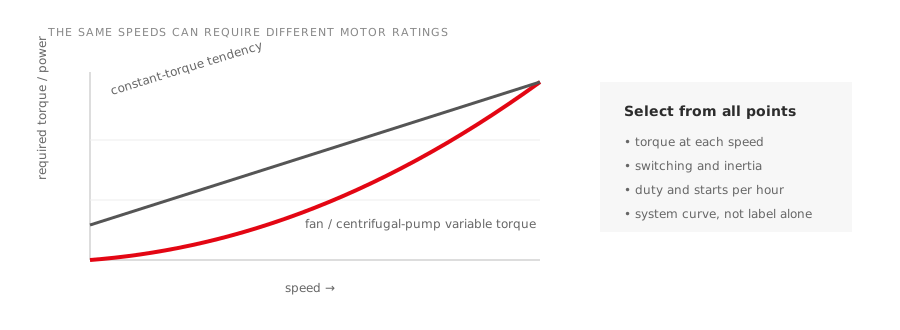
Two motors can provide the same pair of speeds and still be wrong substitutes. The missing information is the load curve.
Direct answer
YD and YDT are pole-changing motor families intended for different application patterns. The general decision is not “which one has the speed I need?” but “what torque and power does the machine require at each speed?”
YDT is oriented toward fan and pump duties where torque typically falls strongly as speed decreases. A general YD duty may follow another torque relationship. The nameplate ratings and the driven-equipment curve must be reviewed together.
Why fans and pumps are different
For a centrifugal fan or pump operating under similar conditions, the affinity-law approximation gives:
- flow approximately proportional to speed;
- pressure or head approximately proportional to speed squared;
- shaft power approximately proportional to speed cubed.
This means a lower speed can require much less power. A winding designed around that variable-torque relationship can allocate its ratings differently from a motor intended to maintain approximately constant torque.
The approximation has limits. Static head, control dampers, system resistance, fluid properties and operation away from the original point can change the result. Positive-displacement pumps do not follow the same cubic-power rule.
Compare the duty before the catalogue
| Driven load | Typical torque pattern | Selection concern |
|---|---|---|
| Centrifugal fan or pump | Variable torque; demand falls with speed | Confirm system curve and low-speed operating point |
| Conveyor | Often closer to constant torque | Starting torque and torque at low speed remain important |
| Mixer | Process-dependent | Material state may dominate breakaway torque |
| Positive-displacement pump | Often constant-torque behaviour | Do not apply centrifugal affinity laws |
| Machine tool | May require constant power over a range | Check torque/power relationship at both speeds |
The table is a screening tool. Obtain the equipment manufacturer’s load curve for final selection.
Switching is part of the duty
Pole changing also introduces a transition-duty question. Define:
- whether switching occurs while coasting, running or stopped;
- transition direction and sequence;
- load inertia;
- starts and speed changes per hour;
- permissible current and torque transient;
- braking or reversing requirement;
- thermal duty at each speed.
A motor that can carry both steady-state points may still overheat if it changes speed frequently. The starter, interlocks and overload protection must recognize each winding connection and rating.
Pole-changing motor or VFD?
A pole-changing motor offers discrete speeds and can be attractive where the process needs only two or several fixed states. It avoids a converter but requires appropriate switching gear and winding connections.
A VFD offers continuous control, smoother acceleration and potential process optimisation. It also requires review of insulation stress, cooling at low speed, bearings, harmonics, cable length and electromagnetic compatibility. The right choice depends on process value, lifecycle support and purchase price.
Enquiry checklist
- Driven-equipment type and manufacturer.
- Required speeds and direction of rotation.
- Torque or shaft power at every speed.
- Breakaway torque and load inertia.
- Switching sequence and frequency.
- Duty type and operating time at each speed.
- Supply, starter and protection arrangement.
- Mounting, enclosure, cooling and ambient conditions.
LEADGO presents YD general pole-changing motors separately from YDT fan and pump-oriented motors. The final choice should follow the verified load curve.
Read every nameplate row
A multi-speed motor should state electrical data for each connection and speed. Record voltage, current, output, speed and duty for every state. Protection based only on the high-speed current may fail to protect the lower-speed connection correctly.
The control circuit must prevent incompatible contactors from closing together and define whether a delay or coast period is required. Commissioning should measure current and process output at each speed, not merely prove that the shaft turns.
Check the process at low speed
For a centrifugal pump, verify that the reduced-speed point still provides required head and avoids an unacceptable region of the pump curve. For a fan, check system resistance, damper position and required airflow. A lower electrical input is not useful if the process no longer performs its task.
When replacing an existing unit, photograph terminal links and the control schematic before disconnection. Record shaft dimensions, both speed ratings, winding connection, starter sequence and measured currents. If the motor has been rewound, verify pole combinations and connection instead of relying only on an old model code.