
Ask about cooling tower motors and the question that comes back is usually about the motor. It is nearly always about the drive train, and the answer starts one level up.
Direct answer
A conventional mechanical-draft cooling tower fan is driven through a chain:
motor → drive shaft → right-angle gearbox → fan
The motor sits outside the tower, a shaft runs through to a gearbox inside it, and the gearbox turns the fan. A direct-drive arrangement replaces three of those four links: the machine mounts in the gearbox position and drives the fan directly.
| Conventional chain | Direct drive | |
|---|---|---|
| Links | Motor, shaft, gearbox, fan | Motor, fan |
| Transmission loss | At each stage | None |
| Maintenance inside the tower | Gearbox oil, couplings, shaft alignment | None |
| Where the machine sits | Outside the tower | In the fan position — inside the airstream |
| Alignment | Long shaft to align and keep aligned | Mounting stiffness and balance |
The last two rows are the trade, and they are why this is a decision rather than an upgrade.
What the tower type decides, before you choose anything
A mechanical draft tower comes in two arrangements, and the difference is where the fan is:
- Forced draft — the fan is on the airstream entering the tower.
- Induced draft — the fan is on the airstream leaving it.
Cooling works by evaporation: ambient air is brought into contact with the falling water, either horizontally across it (crossflow) or vertically upward against it (counterflow).
So the air entering the tower is ambient, and the air leaving it is warm and saturated — it has just been used to evaporate water. The fan duty may be identical in both arrangements. What the machine lives in is not.
On an induced-draft tower, whatever drives the fan sits in that leaving airstream. That is the single most important input to the specification, and it is decided by the tower, not by the motor selection.
This is the same principle set out in replacing a fan motor: the cooling basis of a machine mounted in an airstream is not the cooling basis of a bench-standard machine, and the two are not interchangeable.
What direct drive genuinely removes
The transmission losses. Every stage in the chain takes a cut. Removing the gearbox and shaft removes their share.
The maintenance in the worst place. A right-angle gearbox inside a cooling tower needs oil changes, level checks and seal attention — in a wet, warm, continuously running environment, often at height, and frequently while the tower has to stay in service.
The alignment. A long drive shaft between a motor outside the tower and a gearbox inside it has to be aligned and stay aligned, through thermal movement and structural flexing.
Those are real and they are the reason the arrangement exists.
What it adds, and this part is usually understated
The machine is now in the fan position. It has moved from a relatively benign location outside the tower into the airstream. Everything about its enclosure, cooling arrangement and corrosion protection has to be specified for that.
The mounting carries more. A direct-drive machine sits where the gearbox sat and takes the fan load directly. Mounting stiffness, natural frequency and vibration behaviour become part of the specification rather than the gearbox manufacturer’s problem.
Installation precision matters more, not less. Removing the shaft removes one alignment problem and concentrates the remaining tolerance into a single interface.
None of these makes direct drive a bad choice. They make it a choice that has to be specified, rather than ordered by kilowatts.
Where the energy actually is
It is worth being clear about this, because it is easy to attribute all the benefit to the drive arrangement.
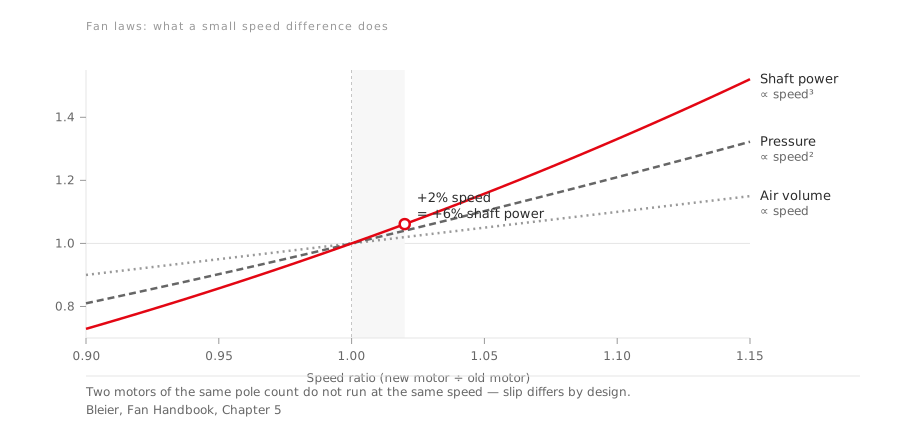
Fan shaft power varies as the cube of speed. A modest reduction in fan speed is a large reduction in power — and a cooling tower is the textbook variable load, because the cooling demand follows the process and the weather rather than running flat out all year.
So the largest lever on a cooling tower fan is usually running it slower when the load allows, and that is available with either drive arrangement. Removing transmission losses is a genuine gain, but it is a smaller one than speed control, and the two are independent decisions.
On savings figures. Percentages quoted for cooling tower drive retrofits depend entirely on what is being replaced, on the tower’s duty profile and on the running hours. We are not quoting one here, because a percentage without those three attached cannot be checked and cannot be applied to your tower.
The four things to settle, in order
- Tower type — forced or induced draft, which sets the environment the machine lives in.
- Fan speed and the tower’s design point, because the drive arrangement fixes it.
- Mounting and structure — stiffness and vibration, particularly for direct drive.
- Control scheme — whether the fan speed will vary with load, which is where most of the energy saving lives.
Ratings come after those four. A conversation that starts with kilowatts has usually skipped the part that decides the outcome.
LEADGO’s DZTYP low-speed direct-drive permanent magnet system is built for the gearbox-position arrangement described here — it replaces the motor, drive shaft and gearbox with a single machine driving the fan directly. The useful first message is the four items above rather than a required output: with the tower type and the control scheme settled, the rating follows, and the environment specification is settled at the same time instead of afterwards.
Going deeper
- Replacing a fan motor — the cube law in detail, and why a like-for-like swap often is not
- Line-start PM motors — permanent magnet efficiency where a converter is not wanted
- What TEFC actually means — enclosure and cooling codes, which is how the environment above gets specified
- Where synchronous machines are used — the wider family the direct-drive machine belongs to