
Ask what a synchronous motor is and the answer comes back as a speed: it runs at exactly synchronous speed, no slip. That is true, and it is rarely why anyone buys one.
Direct answer
The defining property of a wound-field synchronous machine is that you can choose its power factor.
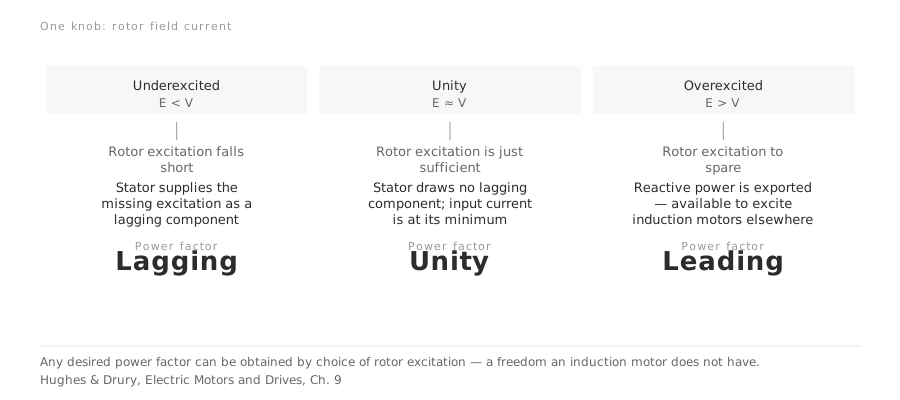
The rotor carries its own field winding, and the current in that winding is yours to set. Three regions follow:
- Underexcited — the rotor’s excitation falls short of what the terminal voltage demands, so the stator supplies the difference as a lagging component. Power factor lags.
- Unity — the rotor excitation is just sufficient, the stator draws no lagging component, and the input current is at its minimum.
- Overexcited — there is excitation to spare. The current rises again but now leads, and the leading power factor represents the export of reactive power — which can provide excitation for induction motors elsewhere on the same system.
As the textbook puts it: any desired power factor can be obtained by appropriate choice of rotor excitation — a freedom not afforded to users of induction motors. The induction machine must draw its excitation from the supply, magnetising current and all. The synchronous machine has a second route.
Everything on this page follows from that one difference.
The three places they are used
1 · Constant speed under varying load. The rotor is locked to the supply frequency, so speed does not droop as load rises. Where a process needs several machines to hold a fixed ratio, or where a speed change is itself a fault, this is the property being bought.
2 · Power factor correction. An overexcited synchronous motor doing real work also supplies reactive power to the system it sits on. One machine can drive its load and improve the site power factor at the same time.
3 · Reactive power on its own — the synchronous condenser. Take the same machine, give it no mechanical load, and run it purely for the reactive power. Overexcited it supplies; underexcited it absorbs. This is a machine deployed as a piece of power-system equipment rather than as a drive.
The naming here is a genuine obstacle for anyone searching: synchronous condenser, synchronous capacitor and synchronous compensator are the same thing. If a specification and a supplier quotation use different ones, that is vocabulary, not a difference in scope.
What it costs: the machine cannot start itself
This is the trade, and it follows directly from how the torque is produced.
Rotor and field have to turn together for there to be any steady torque at all. At any other speed the two slide past one another, and what is left is a pulsating torque that averages to nothing.
So a synchronous machine intended for direct connection to the supply is built with a rotor cage, similar to an induction motor’s, in addition to its main field winding. The sequence is:
- Switch onto the supply. The machine runs up as an induction motor on its cage.
- At just below synchronous speed, switch on the excitation.
- Provided the load is not too high, the rotor makes the final acceleration and pulls in to synchronism.
Three consequences worth knowing before specifying one:
The cage can be small. It is only required during starting, so it can be short-time rated — it is not a continuously loaded component.
Once synchronised, the cage is idle. With steady load and zero slip, no currents are induced in it at all.
But it is not decorative. When the load changes, the cage comes back into use: it damps the oscillations of the rotor as it settles at its new steady-state load angle. A synchronous machine does not glide to a new operating point; it swings to it, and something has to absorb that.
“Provided the load is not too high” is the clause that turns into a commissioning problem. Pull-in is a condition to be checked against the actual load at the actual moment of synchronising — not an assumption.
What this article is not about
A permanent magnet synchronous machine is synchronous in the same sense — its rotor runs locked to the field — but it is a different machine from the wound-field one described here.
| Wound-field synchronous | Permanent magnet synchronous | |
|---|---|---|
| Rotor excitation | A field winding you supply and can vary | Fixed, set by the magnets |
| Power factor | Chosen, by setting field current | A design property, not an operating control |
| Starting on line | Cage, run-up, pull-in | Depends on design; line-start types exist |
The confusion matters because the variability of the excitation is the point of everything above. A PM machine has excellent efficiency and excellent power factor, but it does not give you a knob. Advice about one does not transfer to the other, and search results mix them freely.
LEADGO’s permanent magnet range covers the PM side of that table — line-start machines, high-speed direct drives and low-speed gearless systems. For the wound-field applications on this page, and for condenser duty in particular, the question to put to any supplier is which of the two columns their machine is in, before discussing ratings.
What to establish before asking for a quotation
- Which property you are buying — constant speed, power factor, or reactive power alone.
- Wound-field or permanent magnet, which decides whether excitation is an operating control at all.
- The load at the moment of synchronising, not just the running load — pull-in depends on it.
- The excitation arrangement and how it is switched in.
- How often the load changes, because that is what the damping cage has to handle.
- Whether the machine also has to do useful work, or is there only for the reactive power.
Items one and two settle most enquiries. They are also the two most often left implicit, which is how a conversation about a synchronous condenser and a conversation about a PM drive end up using the same words for several emails.
Going deeper
- PM versus induction motors — the other comparison, and where PM machines earn their place
- Interior versus surface permanent magnet rotors — what “fixed excitation” actually looks like inside the rotor
- Reading a Chinese motor model number — synchronous machines carry their own excitation code in the model string
- VFD reactors and filters — where a drive replaces the need to choose excitation at all