
The usual objection to permanent magnet motors is not the motor. It is the converter: a PM machine normally needs one, and on an existing installation that means a new cabinet, new cabling and a new set of problems. A line-start machine is the answer to that objection — with one condition attached that decides whether it works.
Direct answer
Put both a cage winding and magnets on the same rotor. Then the machine has two modes, and it uses them in sequence:
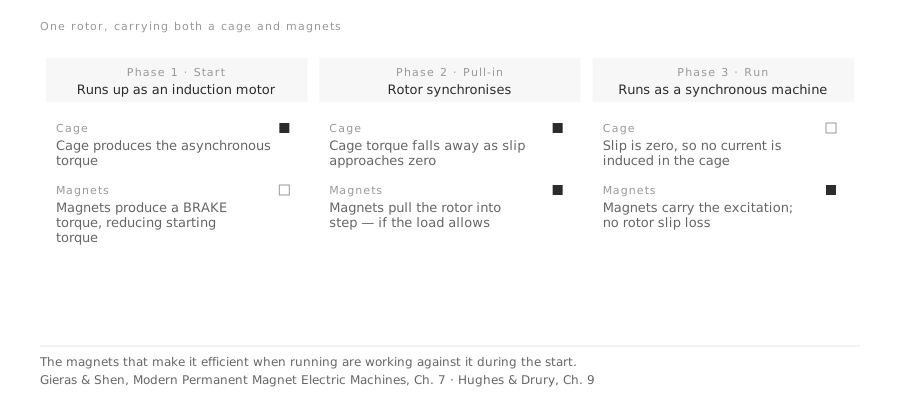
- Start — the cage produces asynchronous torque and the machine runs up like an induction motor.
- Pull-in — as slip approaches zero the magnets pull the rotor into step with the rotating field.
- Run — it runs synchronously at line frequency, with the magnets providing the excitation.
No solid-state converter is involved at any point. That is what “line-start” means, and it is the entire commercial case: the machine goes onto the existing supply, through the existing starter, with the existing wiring.
The gains are real — higher efficiency than an equivalent induction motor, and a power factor that can be equal to unity. A synchronous machine has no rotor slip, and therefore none of the rotor loss that slip implies.
The condition: the magnets fight the start
This is the part that decides whether a line-start machine is right for a particular load, and it is not a detail:
During the starting period the magnets generate a braking torque, which decreases the starting torque and reduces the ability of the rotor to synchronise a load.
The magnets are not switched off during run-up. They are producing a field the whole time, and during the asynchronous phase that field opposes the motion. So the machine that is more efficient than an induction motor when running is weaker than one during the start.
Two consequences follow, and both are about your load rather than about the motor:
Pull-in is a load-dependent event. Whether the rotor makes the final step into synchronism depends on the load torque and the inertia at that moment. The same motor pulls in easily on one machine and fails to on another. This has to be checked, not assumed.
Once running, there is no slip to absorb anything. An induction motor handles a load peak by dipping in speed — that is what slip is for, and it is why high-slip designs exist for cyclic loads like beam pumps. A synchronous machine has no such mechanism. It holds speed until it cannot, and then it falls out of step.
A second consequence, in the rotor itself
The magnets are embedded axially in the rotor core, and that geometry means the rotor bars are unskewed. Skewing the bars is one of the standard ways of suppressing space harmonics in an induction machine, so removing it has an effect:
Compared with induction motors, line-start PM motors produce a much higher content of higher space harmonics in the air-gap magnetic flux density distribution, in the current and in the electromagnetic torque.
That is worth knowing on a noise-sensitive or vibration-sensitive installation. It is not a fault; it is a design consequence of putting magnets where skew would otherwise go.
Where this technology actually fits
Reading the trade-offs in order gives a fairly precise picture of the right application:
| Suits | Does not suit |
|---|---|
| Existing installation where changing the control cabinet is the obstacle | Anywhere the speed needs to vary — that is what the converter was for |
| Steady load, started unloaded or lightly loaded | High starting torque demands, or high-inertia loads |
| Long running hours, where efficiency and power factor pay back | Short duty cycles with frequent starts |
| Loads that do not peak sharply | Cyclic loads that rely on slip to absorb peaks |
The left column is a real and common situation: a plant with an existing motor, existing switchgear and no appetite for a drive retrofit, running the same load for most of the year.
A note on savings figures. Published energy-saving percentages for permanent magnet retrofits vary widely with what is being replaced — the efficiency of the machine coming out matters as much as the one going in. We are not quoting a percentage here, because a percentage without the baseline machine, the load profile and the running hours attached is not information.
What to establish before treating one as a replacement
- Load torque at the moment of synchronising, not just running torque — this is the pull-in question.
- Load inertia, for the same reason.
- Starting frequency — how many starts per hour, since the cage is sized for starting rather than for continuous duty.
- Whether the load peaks, because there is no slip to absorb them.
- Whether speed ever needs to change, which would rule the approach out entirely.
- Noise or vibration sensitivity of the installation, given the harmonic content.
- The existing starter type — a line-start machine still starts across the line unless something else is arranged.
Items one and two are the ones that decide it, and they are properties of the driven machine. A supplier cannot answer them from a motor rating.
LEADGO’s TYC line-start permanent magnet series is built for exactly the retrofit case above — same frame conventions, same supply, no converter. The useful enquiry is the seven items rather than the kilowatts: the rating is the easy half, and pull-in against your particular load is the half that decides the outcome.
Going deeper
- Where synchronous machines are used — the wound-field alternative, where excitation is an operating control rather than fixed
- PM versus induction motors — the broader comparison, and where converters earn their place
- Interior versus surface permanent magnet rotors — where the magnets sit, and what that decides
- VFD reactors and filters — what a converter brings with it, and why avoiding one has value