
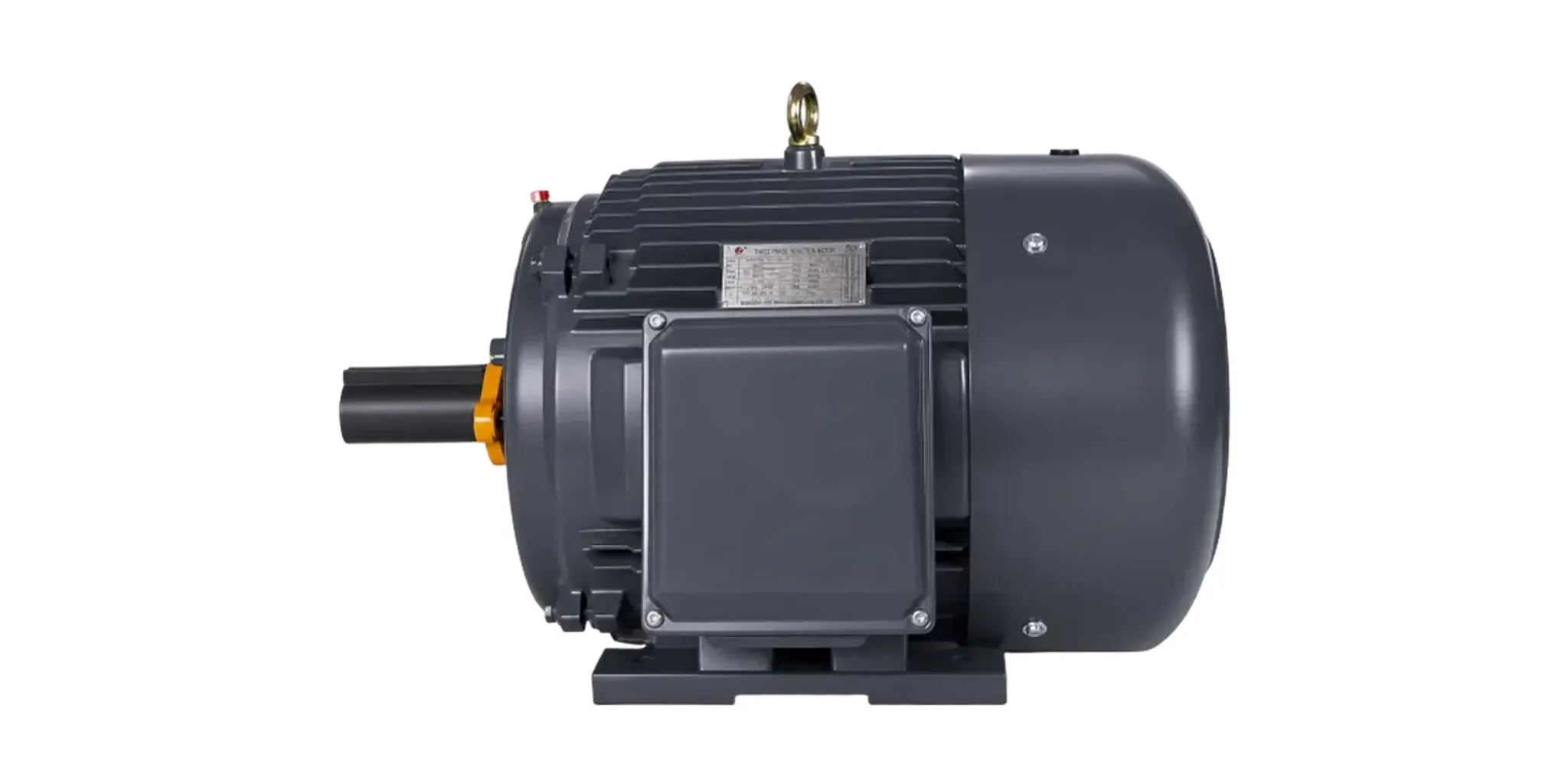
Most nameplate fields describe how the motor behaves once it is running. The code letter describes the high-current locked-rotor condition during starting, and it is easy to copy across a replacement without checking what it represents.
What the letter says, and what it does not
A code letter places the machine in a band of locked-rotor kVA per horsepower, measured at full voltage and rated frequency. Three things follow from that definition and each of them trips somebody up.
It is a ratio, not a current. A code G motor and a code G motor of ten times the rating draw very different currents.
It is a band, not a value. Code G covers 5.6 to 6.3 kVA per horsepower, and the manufacturer is committing to the band rather than to a number inside it.
It is measured at full voltage. Any reduced-voltage starting method changes what actually happens at the terminals, so the letter describes the machine, not the installation.
The table
| Letter | kVA per hp | Letter | kVA per hp |
|---|---|---|---|
| A | 0 – 3.15 | L | 9.0 – 10.0 |
| B | 3.15 – 3.55 | M | 10.0 – 11.2 |
| C | 3.55 – 4.0 | N | 11.2 – 12.5 |
| D | 4.0 – 4.5 | P | 12.5 – 14.0 |
| E | 4.5 – 5.0 | R | 14.0 – 16.0 |
| F | 5.0 – 5.6 | S | 16.0 – 18.0 |
| G | 5.6 – 6.3 | T | 18.0 – 20.0 |
| H | 6.3 – 7.1 | U | 20.0 – 22.4 |
| J | 7.1 – 8.0 | V | 22.4 and up |
| K | 8.0 – 9.0 |
Two details worth having. Each band includes its lower figure and excludes its upper, so 3.14 is code A and 3.15 is code B. And the sequence skips I, O and Q, which is why a plate reading J or P is not a misprint.
Converting to amps
Locked-rotor kVA is the code figure times the rated horsepower. Divide by the line voltage and the square root of three for a three-phase machine:
Locked-rotor amps = (kVA per hp × hp × 1000) ÷ (√3 × V)
A 50 hp motor marked code G on 460 V, taken at the top of the band:
6.3 × 50 = 315 kVA, and 315,000 ÷ (1.732 × 460) ≈ 395 A.
Use the top of the band for a conservative preliminary supply or starter check. Final protection settings require the specific motor’s locked-rotor current, acceleration time and the protective device’s time-current curve; the code letter alone is not enough.
Which figure got marked, when there is more than one
This is the part that is genuinely hard to guess and is written down. MG 1 fixes the rule for every case where a machine has more than one locked-rotor figure:
| Machine | The letter refers to |
|---|---|
| Both 60 Hz and 50 Hz ratings | the 60 Hz figure |
| Y start, delta run | the Y connection |
| Broad or dual voltage | the voltage giving the highest kVA per hp |
| Multispeed | the highest speed it can be started at, except constant-horsepower machines, which use the speed giving the highest kVA per hp |
| Part-winding start | the locked-rotor current for the full winding |
Every one of these resolves to the conservative reading except the first, and the first is the one that matters for export.
Where cross-border replacement goes wrong
Three failure modes, in the order they show up.
The frequency rule. A dual-rated machine carries the 60 Hz letter. Run it on 50 Hz and the plate is describing a condition you are not in. This compounds with everything else that changes between the two grids, and it is the reason the letter cannot be used as a shortcut on a 50 Hz site.
The framework gap. The code letter belongs to the NEMA system. The IEC framework handles starting performance through the design codes in IEC 60034-12 rather than by marking a kVA-per-horsepower letter, so there is no letter to copy across and no clean one-to-one translation. When a machine crosses systems, ask for the locked-rotor figures themselves rather than trying to convert the marking.
The efficiency upgrade. Efficiency class does not determine code letter or locked-rotor current. A specific example is the YBX3-to-YBX4 comparison: their product-standard guarantee envelopes put locked-rotor current roughly 15 to 25 per cent higher and locked-rotor torque about 10 per cent lower for YBX4. Those are guaranteed envelopes rather than measured values, and they are not a universal IE3-to-IE4 rule. They are a reason to check the new rating rather than reuse the old starter assumptions. The same issue sits on the replace side of a rewind-versus-replace decision.
Before you reuse the old protection
- Read the new code letter, not the old one, and convert it at the top of its band.
- Confirm the frequency the letter refers to, and whether it is the one you run on.
- Check whether the machine is dual voltage, and which voltage the letter was marked for.
- If the starting method is Y-delta or part-winding, confirm that the letter matches the method actually wired.
- Check the locked-rotor torque as well as the current. A machine that draws more and pulls less can start slower, which lengthens the thermal event the protection has to ride through.
A supplier should be able to give you locked-rotor current and torque for the specific rating rather than only the band. Our IE4 induction series and YBX4 flameproof series publish their starting characteristics for exactly this reason: the efficiency label alone does not tell you whether the machine will drop into your existing starter.
Related: Same motor, different grid: 50 Hz and 60 Hz · What a 1.15 service factor actually permits · How to verify a motor nameplate’s power rating isn’t inflated