
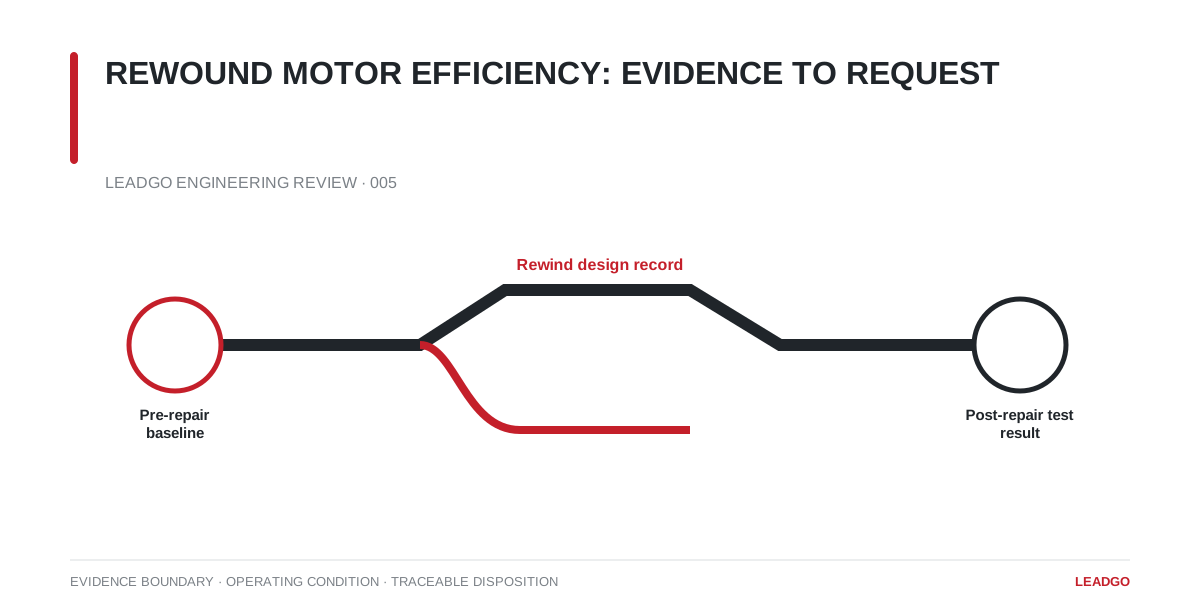
Rewound Motor Efficiency: Evidence to Request can affect equipment selection, commissioning or maintenance. A rewind efficiency claim needs comparable before-and-after evidence, not a visual inspection alone.
Use one consistent machine boundary — rewind-efficiency review
An energy decision is reliable only when the load point, operating hours, supply condition and measurement boundary describe the same duty; the rewind-efficiency review record must identify this boundary explicitly. For this review, identify who owns each input and whether it comes from a drawing, calculation, measurement, test record or site requirement; the rewind-efficiency review record must identify this boundary explicitly. Similar equipment can help frame questions, but it cannot stand in for evidence from the machine under review; the rewind-efficiency review record must identify this boundary explicitly.
Write down the operating state before comparing documents. Rated duty, starting, coastdown, standby and maintenance conditions can expose different limits; the rewind-efficiency review record must identify this boundary explicitly. A value without its condition is easy to carry into the wrong decision; the rewind-efficiency review record must identify this boundary explicitly.
Core review points — rewind-efficiency review
| Review point | Evidence to request | Closure question |
|---|---|---|
| Pre-repair baseline | Applicable drawing, data sheet, calculation or measured record | Does it identify this motor and the relevant operating condition? |
| Rewind design record | Dated design or test evidence with method and revision | Is it comparable with the first input rather than a different duty? |
| Post-repair test result | Approved limit, setting, inspection or disposition | Does it state who accepts the result and what happens if it is not met? |
The three rows form one evidence chain. If one source uses a different rating, temperature, speed, load or assembly state, reconcile the difference before drawing a conclusion; the rewind-efficiency review record must identify this boundary explicitly.
What not to infer — rewind-efficiency review
- Closing on a familiar value. A number taken from another motor, an old project or an unverified spreadsheet may look plausible; the rewind-efficiency review record must identify this boundary explicitly. Keep it as a reference only until its applicability is demonstrated.
- Separating the final check from the first two. Post-repair test result may depend on both pre-repair baseline and rewind design record. Treating it as an isolated form field hides the real interface.
Also avoid converting an unanswered question into a silent assumption. Mark it open, name the owner and record what evidence will close it; the rewind-efficiency review record must identify this boundary explicitly. That is faster to manage than discovering the missing boundary during testing or site work; the rewind-efficiency review record must identify this boundary explicitly.
How to work through the issue — rewind-efficiency review
- Identify the motor, driven equipment, supply or site boundary affected by the decision; the rewind-efficiency review record must identify this boundary explicitly.
- Confirm pre-repair baseline and note the exact source revision.
- Review rewind design record under the same operating case.
- Compare both with post-repair test result, including any alarm, inspection or approval action.
- Close the item with an approved disposition, or leave it open with an owner and due date; the rewind-efficiency review record must identify this boundary explicitly.
This sequence works during specification, vendor-document review, factory testing and maintenance planning because it keeps the technical question connected to a decision; the rewind-efficiency review record must identify this boundary explicitly.
Minimum record set — rewind-efficiency review
Retain the machine serial or project tag, document revision, test or measurement date, operating condition and reviewer; the rewind-efficiency review record must identify this boundary explicitly. If a concession or temporary limit is used, record its scope and expiry; the rewind-efficiency review record must identify this boundary explicitly. Photos and plots are most useful when their locations, channels and units are identified; the rewind-efficiency review record must identify this boundary explicitly.
The result should let another engineer reconstruct why the motor was accepted, monitored, repaired or held; the rewind-efficiency review record must identify this boundary explicitly. It should not depend on a private email thread or on someone remembering which version was discussed; the rewind-efficiency review record must identify this boundary explicitly.
Decision rule — rewind-efficiency review
A rewind efficiency claim needs comparable before-and-after evidence, not a visual inspection alone. Apply the rule to the credible limiting condition, not only the easiest rated point; the rewind-efficiency review record must identify this boundary explicitly. When evidence conflicts, resolve the machine identity and test boundary before averaging or selecting the preferred result; the rewind-efficiency review record must identify this boundary explicitly.
Going deeper — rewind-efficiency review
Before/after evidence scorecard — rewind-efficiency review
Score comparability before discussing an efficiency difference. Missing boundary information cannot support a measured improvement or loss.
| Evidence item | Strong comparison | Weak comparison |
|---|---|---|
| Machine identity | Same serial/tag and configuration | Similar frame or replacement nameplate only |
| Test method | Same method/loss treatment or documented conversion | Different methods without reconciliation |
| Supply | Recorded voltage, frequency and balance | Unrecorded or materially different supply |
| Thermal condition | Stabilised or corrected on stated basis | Cold test compared with hot test |
| Load points | Comparable points in operating region | One arbitrary point or no-load only |
| Instruments | Calibrated, stated uncertainty | Shop-display readings without traceability |
| Repair changes | Winding, core and mechanical work recorded | “As original” without winding sheet |
If several rows are weak, call the result a post-repair baseline, not proof that original efficiency was preserved.
Capture evidence before dismantling — rewind-efficiency review
Record nameplate, connection, leads and identity. Collect factory data, operating load/current history, temperature/vibration trends and failure reason. A damaged motor may not be safe to efficiency-test, but no-load current, resistance, core condition and dimensions can still explain later results.
Do not discard the winding before recording coil span, turns, conductor arrangement, connection, parallel paths, end-winding geometry and core dimensions. Photograph and sign the winding sheet. If burnt beyond recognition, state the reconstruction basis and uncertainty.
Control repair variables affecting loss — rewind-efficiency review
Core damage or uncontrolled burnout can affect iron loss. Winding changes can affect copper loss and temperature. Bearing, fan, seal and air-gap changes can affect mechanical behaviour. The plan should identify core assessment, stripping method, lamination inspection, winding replication or redesign, conductor area, impregnation, air gap, bearing fits and fan configuration.
Not every repair requires a full efficiency laboratory test. The claim level must match evidence. If retention is contractual, specify test method and acceptance before repair starts.
Post-repair test package — rewind-efficiency review
Request resistance with temperature, insulation tests appropriate to the system, no-load current/power, vibration, bearing temperatures and a load/efficiency test where contracted. The efficiency report should identify method, instruments, calibration, supply quality, temperatures, load points, loss treatment, corrections and uncertainty.
A no-load comparison supports workmanship but does not equal a full efficiency determination.
Applicability and limitations — rewind-efficiency review
This applies to repaired induction motors where energy performance affects acceptance or repair-versus-replace decisions. It cannot recreate a missing pre-failure efficiency. Nameplate efficiency is a rated declaration, not necessarily the measured value of that individual machine.
Field input power alone cannot determine motor efficiency without credible shaft output. Process load, voltage and power factor can overwhelm a small change. Use field trends as context, not a substitute for controlled testing.
Common errors — rewind-efficiency review
- Comparing a post-repair result directly with nameplate efficiency and calling the difference rewind loss.
- Accepting a megohm or no-load-current test as proof of efficiency.
- Failing to record winding data before stripping.
- Changing fan or bearings without recognising effects on losses and temperature.
- Quoting more precision than uncertainty supports.
- Ignoring annual load profile in the commercial decision.
Supplier data and commercial decision — rewind-efficiency review
Ask for incoming inspection, winding sheet, core assessment, stripping method, laminations, winding materials, connection, impregnation/cure, changed parts, dimensions, balance and final tests. Require deviations to be approved before irreversible work.
Translate accepted efficiency evidence into annual energy only after defining load and hours. If alternatives differ by input power ΔP at a representative point, illustrative annual energy difference is ΔE = ΔP × operating hours. Apply site energy price and sensitivity, plus reliability, downtime, lead time and remaining life. A small uncertain efficiency difference should not dominate a large production consequence.
Retain the post-repair test as the new baseline. Future temperature, current and vibration can then be compared with a known assembled condition even when original efficiency evidence was incomplete.